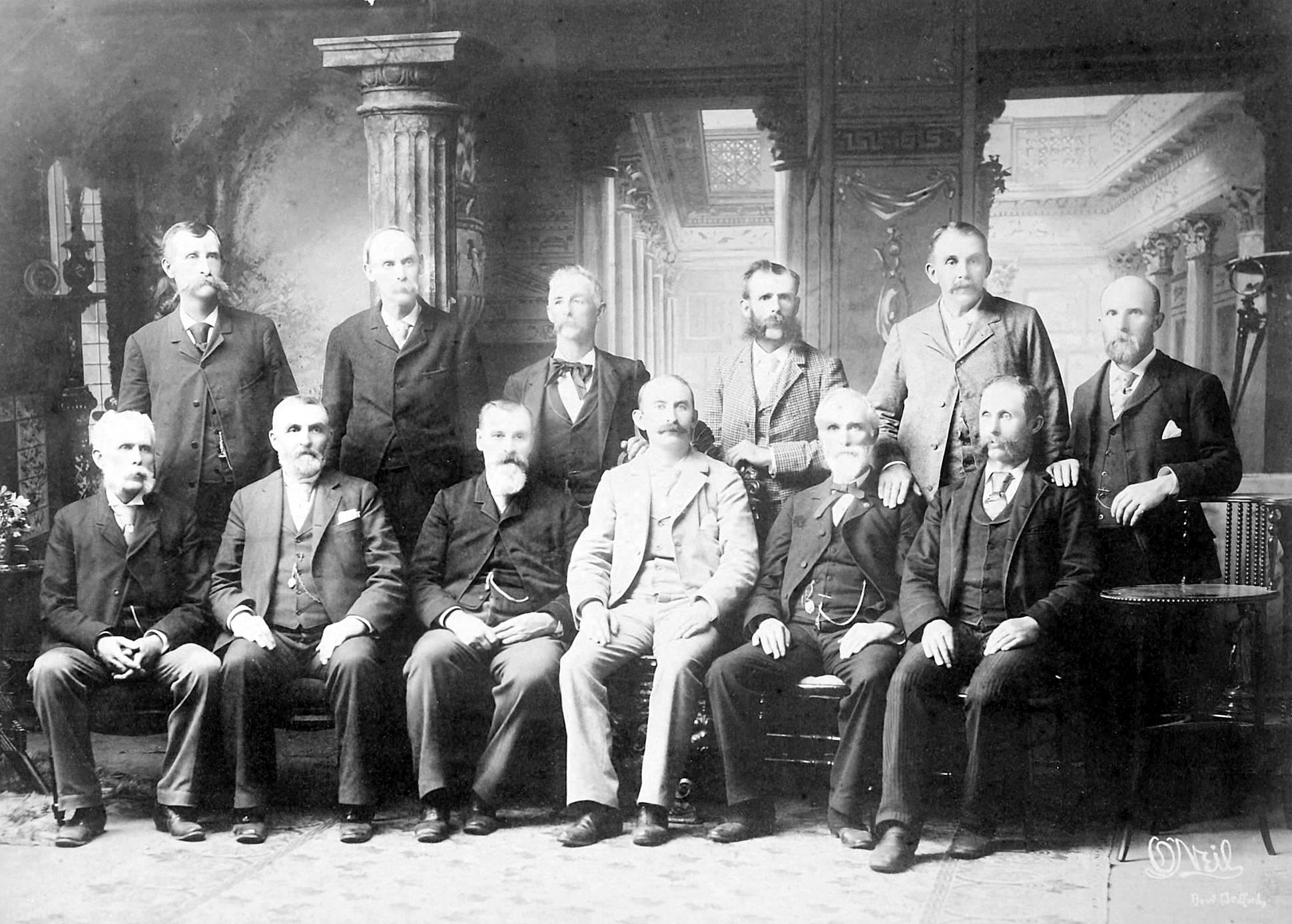
Photo: Lizzie Borden's jury, from her Wikipedia page
--Lizzie was later seen to burn the dress she wore when they were killed. This is unusual in of itself, and very suspicious, but especially considering that the family was so frugal, they often ripped up unused clothing to use as rags. (It was also said they all got sick because the father insisted they keep a mutton stew that the maid said had gone bad. The father was notoriously frugal.)
--There were no signs of struggle in the rooms, the bodies, or the clothes of the victims. This most likely means that no one unknown to the victims accosted them.
--The stepmother was killed first. The wound patterns show that her killer had to straddle her, thereby attacking angrily from the front, showing power by essentially sitting on her, and then exhibiting enraged overkill by killing her with a hatchet (not an ax) and inflicting 19 hatchet cuts in her face--and only in her face. This shows that the murderer knew the victim and was exhibiting rage towards the victim. The first cut was enough to kill, but 18 more followed to the face anyway, thereby obliterating the face, and, in a psychological way, the victim herself. It was proven that Lizzie very much disliked her stepmother, telling tons of people that, and by constantly pointing out that she was her stepmother, not her mother. That immense dislike--either because this woman had "replaced" her mother, or because she was going to receive the barns, properties and about $500,000 if the father died first--was manifest in the method of the crime.
--The father, killed second, was also a victim of overkill, in which the first wound was enough to kill, but was followed by 10 more anyway. He was also attacked only in the face, which profilers say is indicative of a personal crime, for the reasons mentioned above. But the difference here is that he was killed in his sleep, which profilers say is indicative of a killer who feels powerless in front of this person normally. This victim, killed like this, is usually someone who so dominates the killer that the killer must kill him while the victim is asleep. Think Claudius and King Hamlet here.
--Though not indicative of anything by itself, Lizzie was a known kleptomaniac around town. Local merchants would quietly invoice the father and he would quietly pay them.
--Though never proven, the psychological aspects of the people involved hint at sexual abuse. The father fits the profiling prototype of someone who would do so, and Lizzie fits the psychological prototype of someone who would be a victim of it. This would explain the stealing, the anger towards the stepmother, the anger towards the father, and the anger that she would not benefit from her years of victimization when the stepmother inherited everything. This is all circumstantial, but the authors I'm reviewing say that they have seen such prototypes and actions tons of times.
--The order of crimes is important. Had the father died first, the properties and most of the monies would go to his wife. If she died after him, all of that stuff would go to her family--not Lizzie and her sister. But since she died first, all of that remains his, of course, but she and her family cannot inherit anything legally. Then when he dies second, a will that was rumored to give his wife almost everything is null and void; all things therefore go to his daughters.
--Lizzie supposedly said she'd found her father's body, and asked the maid and a neighbor to go get the doctor and police. Wouldn't she have left the house if she'd thought a crazed killer was still in the house? Similarly, she asked the maid to then go upstairs and see if the stepmother had returned to the house, as Lizzie had said that she'd recently seen her return home. Would the maid go up there if there was still a killer around? Profilers say that the killer doesn't want to be the one to "find" the body, so Lizzie sending the maid upstairs to "find" the stepmother's body makes sense.
--Lizzie sent photos of her trial to the prosecutor after the trial, writing that he may like them "as souvenirs of an interesting occasion." That's taunting, typical of this type of offender, especially when they feel they're getting away with their crimes. It's a dare. Or, in this case, a finger.
Misunderstood? I don't think so, especially by the authorities of the time. They knew they had the right one. The jury didn't, of course. Speaking of which, a few similarities between this and the O.J. trial:
--Both trial juries were over-influenced by bias, Lizzie's sexism and O.J.'s racism. As an example of the sexism, a bucket of rags and blood were found in the house. Lizzie said it was all from her periods. Though this was doubted, several men stated in writing that they were not about to test it to make sure. There are many other examples of this.
--Both were acquitted by a jury but convicted by the public before, during and after their trials.
--Both were referred to as "The Trial of the Century" by the media.
--Both people on trial offered huge rewards for the location of the real killer.
--Both rewards have never been taken.
--Both committed burglary after these trials. Simpson is in jail for his; Lizzie stole a couple of inexpensive paintings from Providence, RI and had to pay a fine.


