Photo: Caylee Anthony
First of all, for full disclosure: I didn't watch most of the trial, and most of what I have to say has to do with the little I did watch, and what was in the papers. (I try not to pay attention to the talking heads; I admit that the papers are often not much better.) I also point out that being on the jury and talking about being on the jury are two entirely different things.
So I pointed out to someone recently that the defense did not have to prove that Casey did not commit murder. I had to say this because this person said that her defense didn't prove that she didn't do it. I brought up 12 Angry Men, and got a blank look, so I just mentioned that the defense doesn't have to prove that she didn't do it (good thing, because it sure didn't) and it doesn't have to make her testify in her own defense (another good move; the prosecution would've roasted her alive and her defense would've gone up in flames). The only thing that matters here is that the prosecution must prove without a reasonable doubt (important phrase) that she DID do it, and that she did so with all definitions of murder; that is to say, premeditation, etc. Clearly the prosecution did not prove this; I can understand this. Another caveat is that Florida has the death penalty, and the jury felt maybe that the prosecution didn't have enough to hand down a guilty verdict knowing that she'd maybe go to the chair (or whatever Florida's method is). I understand that as well. See 12 Angry Men again for a good example of this.
What I don't get is that the prosecution allowed the jury to hand down a lesser verdict of manslaughter if the jury felt that was more prudent. I have to admit that I don't know why they didn't do that. Casey bought chloroform and researched its uses on the internet. If you want to say that you can't prove it wasn't her father or someone else using the computer at the time of the research, okay, but what about buying the chloroform? What about when she backed the car up in the garage and put shovels in the trunk? What about all the lies she told investigators--which even this jury admitted she did? What about the car smelling of death? What about her excessively inappropriate behavior after the disappearance but before the body was found, when, as it turns out, she knew her daughter was dead, such as partying, smiling, getting tattoos, etc.?
The jury response, apparently, is that it all doesn't matter. I understand most of the above is circumstantial evidence, but the chloroform and shovels? The research? And for manslaughter, if not for murder? I don't know; I've seen people convicted on less, especially for manslaughter, which, again, was an option for this jury. It also said that she was not guilty of child abuse, which I also do not understand, as she was the mother, and there was ample evidence of abuse.
So, again, I didn't see most of the trial. I can't speak of the prosecution's missteps, if there were any. But I can tell you this: Before the jury's verdict for the O.J. trial (you knew the comparison was coming), the media was screaming at every single prosecution mistake--of which there were a great many. I didn't see that here. I did see (on television), however, what I saw as an inept defense. (Find that blog entry below.) Apparently I was very wrong, but for the life of me, I wouldn't want that team defending me. Well, now, after this, maybe I would.
I leave this trial now under the impression that the jury would tell us that they voted "not guilty," not "innocent." I believe each juror feels that she did it, or had something substantial to do with it, but that it just wasn't proven to their satisfaction. I don't find fault with this jury as I did with O.J.'s jury. I think they knew they'd be crucified for a "not guilty" verdict and gave it anyway because they believed it was just. I respect that. (The O.J. jurors, by comparison, seemed blown away by the negative reaction towards them, as if they'd never considered the aftereffects.) So be it; a jury shouldn't hand down a verdict depending on whatever repercussions they believe they'll sustain, anyway. I agree with the prosecution's guy when he said that everyone did their jobs well--prosecution, defense, jury, everyone. I believe that. I believe that the prosecution is probably devastated, despite that guy's brave face, and I'd be surprised if some of them didn't believe that they'd failed a 2-year old girl. I'd be surprised if a couple of the jurors didn't feel the same way.
I'd love to know what the jurors were thinking, but they're not talking yet, and I don't blame them for that, either. They'll talk when their book deals come out, I assure you. In a way, I don't blame them for that. I don't blame the judge for anything. No Lance Ito here. And Casey will never again be charged with this crime, or any of the others, since she was technically charged with the possibility of manslaughter, etc. She is, and always will be, free. She won't get a job again until she changes her name, but the public has a short memory, and with a name change and a different living place, she'll be fine. Nike resigned Michael Vick, after all. I believe she got away with something, but I also believe the system worked. I'd like the father and brother investigated, and Casey had better stay sober for the rest of her life, but it is what it is. It sucks, but we have no choice. Let's move on.
Showing posts with label O.J. Simpson. Show all posts
Thursday, July 7, 2011
Friday, May 6, 2011
Zodiac
Just watched David Fincher's Zodiac. (Fincher is another director everyone should know by name, and doesn't. He directed Se7en [over-rated] and The Social Network [under-rated], among other things.) Watched this, and cross-referenced occasionally with Robert Graysmith's book, and even bookmarked Donovan's "Hurdy Gurdy Man" as it's so haunting. Cleaned the office and checked the Sox game while I was at it. I do more when I'm doing more.
Anyway, I was struck by how much of a labyrinth these types of cases are. It seems (more so from the movie than from the book) that 95% of the "evidence" is a series of interesting dead ends that lure the driven like the Sirens to their obsessive destruction. Certainly a few of the real-life men were driven to near-insanity (and temporary insanity) by this case. Yet when all was said and done, it's like what Hannibal Lecter said: "We covet that which we see every day." Find the first victim; find who knew and possibly lived near the first victim; find out who fits the profile of the evidence presented. (Bob Starr, one of the more likely suspects, lived 50 yards from the first victim, and knew her.) In other words, keep it simple. Play the odds. Don't play politics.
And don't fuck up the evidence, or the crime scenes.
I say this last because I thought of the JonBenet Ramsay and O.J. cases throughout the movie. Tons of suspects and red-herrings. Screwed-up crime scenes; tampered evidence. I just saw an episode of Autopsy in which the head coroner said the same thing: both murder scenes were tampered to the extent that cops were leaving bloodied handprints and shoeprints all over the place. (The coroner said he spoke up right away about there being two killers. He thinks O.J. was one of them.) Anyway, these cases remain unsolved, either truthfully unsolved, or, as in the case of O.J.'s, "unsolved," because a) the cops screwed up the crime scenes and the gathering of evidence; b) the cops played politics, fought over jurisdiction, didn't share all the evidence with each other; c) the cops screwed up the interviews; d) the cops got carried away by interesting red-herrings (although, of course, they rightfully don't know this until the dead-end moment happens); e) too much time passes and people die and/or forget things; f) evidence gets lost...
You get the idea. A labyrinth nightmare. The Zodiac case and the JonBenet Ramsay case are similar in these ways, as the Green River case and maybe the Ripper case was as well. In the latter two, as I believe also with the Zodiac case, the cops knew who the most-likely killer was but were unable to officially charge or arrest him for a plethora of reasons. Such cases are an Odyssey of obsessive, nightmarish proportions. No wonder they're not solved.
And a great quote from Graysmith's book, I found almost at random: "I have a therapist who says, 'The trick is to learn you can't corral all the rattlesnakes,'" says Fincher. "'You just got to know where they are.'"
Sunday, April 17, 2011
Lizzie Borden: Misunderstood? Part 2
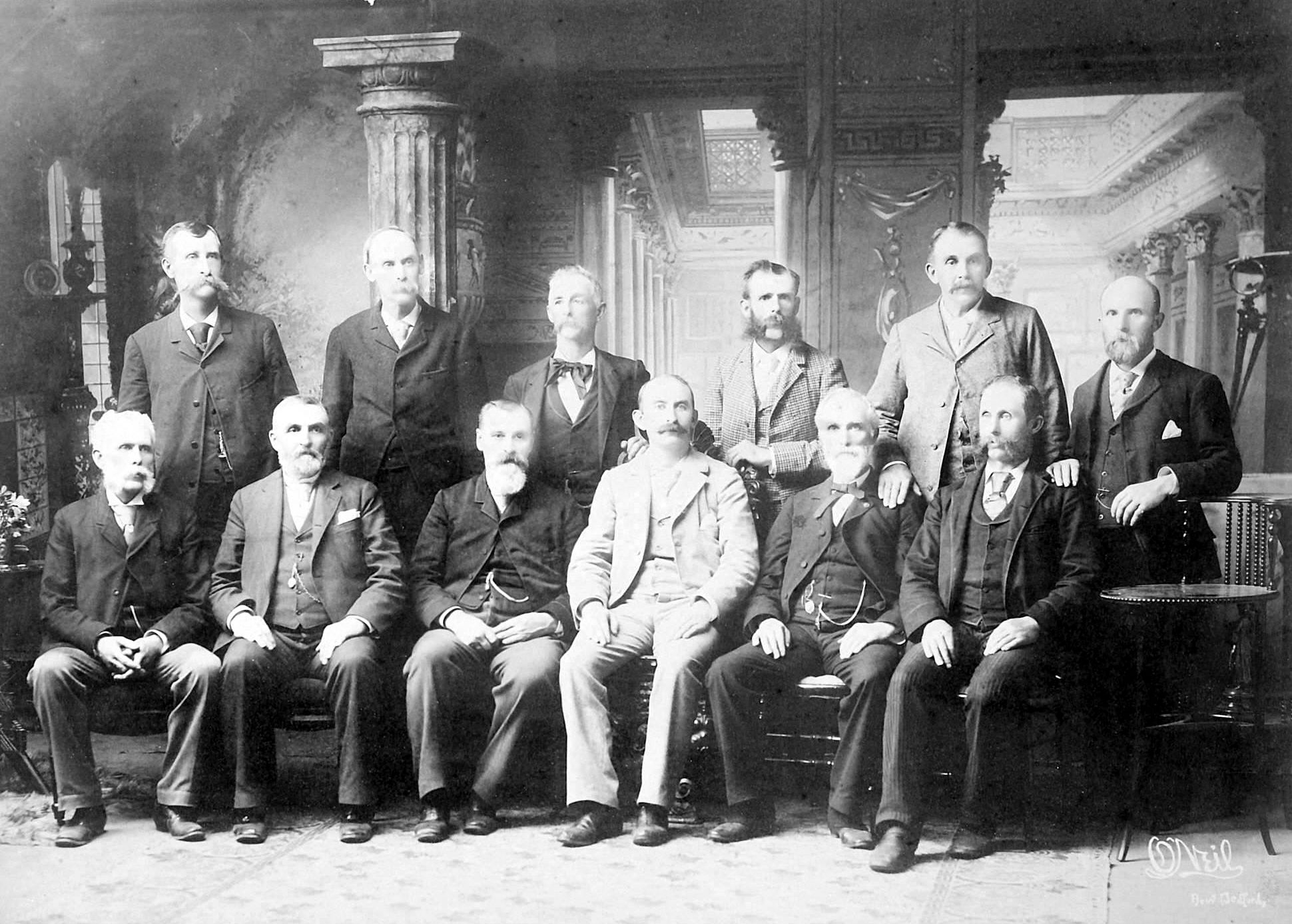
Photo: Lizzie Borden's jury, from her Wikipedia page
--Lizzie was later seen to burn the dress she wore when they were killed. This is unusual in of itself, and very suspicious, but especially considering that the family was so frugal, they often ripped up unused clothing to use as rags. (It was also said they all got sick because the father insisted they keep a mutton stew that the maid said had gone bad. The father was notoriously frugal.)
--There were no signs of struggle in the rooms, the bodies, or the clothes of the victims. This most likely means that no one unknown to the victims accosted them.
--The stepmother was killed first. The wound patterns show that her killer had to straddle her, thereby attacking angrily from the front, showing power by essentially sitting on her, and then exhibiting enraged overkill by killing her with a hatchet (not an ax) and inflicting 19 hatchet cuts in her face--and only in her face. This shows that the murderer knew the victim and was exhibiting rage towards the victim. The first cut was enough to kill, but 18 more followed to the face anyway, thereby obliterating the face, and, in a psychological way, the victim herself. It was proven that Lizzie very much disliked her stepmother, telling tons of people that, and by constantly pointing out that she was her stepmother, not her mother. That immense dislike--either because this woman had "replaced" her mother, or because she was going to receive the barns, properties and about $500,000 if the father died first--was manifest in the method of the crime.
--The father, killed second, was also a victim of overkill, in which the first wound was enough to kill, but was followed by 10 more anyway. He was also attacked only in the face, which profilers say is indicative of a personal crime, for the reasons mentioned above. But the difference here is that he was killed in his sleep, which profilers say is indicative of a killer who feels powerless in front of this person normally. This victim, killed like this, is usually someone who so dominates the killer that the killer must kill him while the victim is asleep. Think Claudius and King Hamlet here.
--Though not indicative of anything by itself, Lizzie was a known kleptomaniac around town. Local merchants would quietly invoice the father and he would quietly pay them.
--Though never proven, the psychological aspects of the people involved hint at sexual abuse. The father fits the profiling prototype of someone who would do so, and Lizzie fits the psychological prototype of someone who would be a victim of it. This would explain the stealing, the anger towards the stepmother, the anger towards the father, and the anger that she would not benefit from her years of victimization when the stepmother inherited everything. This is all circumstantial, but the authors I'm reviewing say that they have seen such prototypes and actions tons of times.
--The order of crimes is important. Had the father died first, the properties and most of the monies would go to his wife. If she died after him, all of that stuff would go to her family--not Lizzie and her sister. But since she died first, all of that remains his, of course, but she and her family cannot inherit anything legally. Then when he dies second, a will that was rumored to give his wife almost everything is null and void; all things therefore go to his daughters.
--Lizzie supposedly said she'd found her father's body, and asked the maid and a neighbor to go get the doctor and police. Wouldn't she have left the house if she'd thought a crazed killer was still in the house? Similarly, she asked the maid to then go upstairs and see if the stepmother had returned to the house, as Lizzie had said that she'd recently seen her return home. Would the maid go up there if there was still a killer around? Profilers say that the killer doesn't want to be the one to "find" the body, so Lizzie sending the maid upstairs to "find" the stepmother's body makes sense.
--Lizzie sent photos of her trial to the prosecutor after the trial, writing that he may like them "as souvenirs of an interesting occasion." That's taunting, typical of this type of offender, especially when they feel they're getting away with their crimes. It's a dare. Or, in this case, a finger.
Misunderstood? I don't think so, especially by the authorities of the time. They knew they had the right one. The jury didn't, of course. Speaking of which, a few similarities between this and the O.J. trial:
--Both trial juries were over-influenced by bias, Lizzie's sexism and O.J.'s racism. As an example of the sexism, a bucket of rags and blood were found in the house. Lizzie said it was all from her periods. Though this was doubted, several men stated in writing that they were not about to test it to make sure. There are many other examples of this.
--Both were acquitted by a jury but convicted by the public before, during and after their trials.
--Both were referred to as "The Trial of the Century" by the media.
--Both people on trial offered huge rewards for the location of the real killer.
--Both rewards have never been taken.
--Both committed burglary after these trials. Simpson is in jail for his; Lizzie stole a couple of inexpensive paintings from Providence, RI and had to pay a fine.
Saturday, April 16, 2011
Lizzie Borden: Misunderstood? Part 1
Image: Lizzie Borden, from her Wikipedia page
A new book by the curators of the bed and breakfast in Lizzie Borden's former house purports that she was "misunderstood" and that she was "probably not guilty." The curators say that her private letters and the opinions of those close to her both point to the probability that she did not kill her father and stepmother in that house in the Victorian 1890s. Also, they point out, the evidence was circumstantial, and the axe that she supposedly used had no blood on it, and the hair on it wasn't that of anyone in the family, including hers, her older sister's, or her father or stepmother. And, after all, she was found not guilty.
I've read a bit on this case, and the work that stands out to me is Douglas's and Ohlshaker's The Cases that Haunt Us, which presents the facts, evidence, suspects and atmosphere of famous crimes, including those of Lizzie Borden, JonBenet Ramsay, Jack the Ripper, and others. (I recommend this book immensely, and you can click on my Goodreads link above to read my review of it.) Anyway, John Douglas, a popular profiler, is convinced that she did do it, and presents these reasons:
--If she didn't, who did? Not a stranger breaking in: the stepmother had been killed 90 minutes before the father came home and got killed. A stranger would not have been able to kill her, hide for 90 minutes with Lizzie, her sister Emma, and the live-in maid, all in the house, not seeing the murder or the stranger, and then kill the father with no one seeing or hearing it, and then leaving with nobody seeing him.
--Lizzie had the best motive of anyone: If the father died first and left everything to the stepmother, both daughters were worried that they wouldn't get anything from her. This was a real possibility, as he was 70, very rich, and the probability that the stepmother would get everything was rather high.
--She'd said that during the murders, she'd been in the top loft of the barn, finding lead weights to make sinkers for an upcoming fishing trip. But an officer soon went up there and found a heavy, undisturbed bed of dust on the floor. No footprints at all to indicate that anyone had been up there.
--Lizzie changed from a blue dress to a pink and white dress while policemen were around. What innocent person would be so unshocked that she would think to change up? (And what kind of law enforcement would allow her to do so?)
--Bloodspots were found on her shoes and underskirts. When asked to explain, she'd said it was due to her period, but later tests concluded that the underskirt was soaked from the outside in, not from the inside out. (She'd called her period a "flea bite," a euphemism at the time.)
--Shortly before the murders, she'd tried to buy small amounts of poison from two pharmacies, neither of which would give them to her. She'd denied being at these places, but a customer and pharmacist in one of them testified that she had been there.
--The morning of the murders, Lizzie, her sister, the maid, the stepmother and the father had all complained of bad stomach pains and other illness. The father had to stop his morning business at his properties because, as he told a few people, he felt very ill. They testified that it was very unusual for him to stop business due to any illness.
--Not evidence, just weirdness: The coroner wanted to do another autopsy, so after the funeral, he took the bodies, cut off the heads, unfleshed them and did his tests. Then the heads were reburied with them, but at their feet!
To be continued in another post...
Subscribe to:
Posts (Atom)