I read this book partly because I'm researching a book of my own that takes place partly in 1892--ten years after the 1882 of this book, but still, I didn't have any 1880s information at all. Turns out, Finney infamously uber-researched for this book. In fact, it seems that the sole reason he wrote this book is to simply describe 1882 until it felt like he lived there.
This he does. If you're at all interested in the past--and the 1880s in particular--you should read this book. If you live in New York City and want to know how Broadway and Fifth Avenue and the many buildings constructed in that time became alive in their own right, and then grew into the life's fabric of the city, you should read this book. If you're even a little bit a traveler or an explorer at heart--if you're even a little curious or interested in history and people at all--you should read this book. And if you think it's interesting to understand the people of the era--the actual, flesh-and-blood people of a time--more than just the important historical facts themselves (as I do), then you should read this book.
In short, this was quite a little pleasure, a rare, quaint joy that reading should bring but often does not, even when reading a good or important book. This gets you away. Not just into 1882 NYC, but the mid- to late-Victorian Era of your own town and city. Have you ever wondered what it was like in 1882 where you are? This book may give you an idea. Chances are, it was like this, just maybe on a lesser scale.
But the air was clean and the people were evidently a little more carefree than the early pictures would have us believe. There were horses and sleighs everywhere; children played outside, even in the winter. There were no screens to enslave us, no computers to weigh us down. People awoke early, at sunrise, and went to bed just after sundown. There were telegraph wires everywhere, like electric wires today, so the landscape wasn't as bare as you might think. The el rattled the city, and electric trains shouldered aside horse-drawn carriages and coaches. Everyone walked, and people probably spent more time with each other.
This is romanticized history, of course. You won't see how the very poor live here; in fact, the author just barely refers to them at all. Most of the action takes place in the richer Broadway, Fifth Avenue part of Manhattan. There aren't minorities here, either--these things, and the way Finney handles female characters, make the book seem a little less sophisticated than what we may be used to today. They aren't jarring, and they aren't what this particular story is about, but there it is nonetheless.
It was written by the guy who wrote the original Invasion of the Body Snatchers (that was the other reason I wanted to read this), so there's a slight sci-fi aspect here, but it is very slight. This is more historical fiction than it is science fiction. It's a bit of fantasy, too, if you think of 1882 NYC as another world, which it sort of is.
My favorite thing about this book (and books like it) is the sense of wonder that it instills in the reader. Finney clearly was enjoying himself as he wrote this, and the writing and tone exude a sense of wonder that he himself must have been feeling while writing this. You get the feeling that if Finney has the chance to walk into 1882 NYC and to stay there, he would have as well.
Would you want to stay in the 1882 of your own place?
Showing posts with label Manhattan. Show all posts
Showing posts with label Manhattan. Show all posts
Saturday, September 12, 2015


Wednesday, August 14, 2013
Stealing Shakespare--The Shakespeare Thefts (book review)

Photo: A 1623 First Folio in the Victoria and Albert Museum, in London. From the Wikipedia page, "First Folio."
Extremely easy-to-read and interesting book, but probably only for those interested in Shakespeare, his folios, or really old books. I talked about this recently with a friend and she just rolled her eyes.
But I thought it was interesting, and the author's fascination and joy of his subject also leaps off the page. He clearly loves what he does, and he is clearly very knowledgeable of what he does.
What is that, exactly? Well, he's a Shakespearean scholar, and an overall authority on the 1623 Folio, and its 250 or so copies out there, out of the 750 total copies that had been made in 1623--and sold without binding. If you were alive in 1623, and if you bought the First Folio, you bought it in manuscript form--a pile of paper (or cloth, actually), and then you paid one pound extra (25% of your yearly average income in 1623) to have it bound, often in calf-skin. (The author, Eric Rasmussen, believes there are maybe 250 more out there, somewhere, possibly in boxes in libraries--or in somebody's attic.) His lifelong ambition: to very minutely survey and catalog every single copy of the 1623 Folio out there. To authenticate every page of every folio out there. To find missing folios. Why? Because they're frequently stolen, because even one in poor condition is worth a few million, and because...well, because he's sort of a fanatic about it. And I mean that in a very, very complimentary way. Had I the education of this stuff, and the time and the money, I would definitely join him on his travels. Though the whole waiting, and the dealing with people, I would have to leave to he and his team. I mean, if there were a painting of the real Shakespeare (there probably isn't one), wouldn't you want to own it, regardless of the value? (Rasmussen bought a painting he hoped would be of Shakespeare, since the provenance made it a possibility. But his purchase had been painted over. He still hopes it's Shakespeare, but it isn't.)
I don't know how to explain the joy someone would have about reading stuff like this, except to maybe give you an example. I'm sort of a nut about old baseball cards as well. The cream of the crop for such things is the 1909-1911 T206 Honus Wagner card, which even in poor condition is worth hundreds of thousands of dollars. A very good one sold recently for seven million dollars. People are absolutely fanatic about this card. Many would steal it, if given the chance--and not for the money. Just for the chance to hold one. And to own one? Heaven. Bliss. I feel that, too. I saw one a few years ago at the New York Public Library in Manhattan. Someone thought it would be a great idea to paste that one to a scrapbook page, so that all anyone would ever see of that card is the front of it. Not only does this greatly reduce its value, but it's not about the money--it's about the awesomeness of the card itself. If you can say, "So the hell what?" then maybe this book isn't for you. But if that makes you grind your teeth with frustration and anger, because some idiot made it impossible for anyone ever again to turn that card over to see the back, you'd enjoy this book. The card is so awesome that it deserves to get turned over and seen in its totality, you know? ::sigh::
The stories in this book about the trials and tribulations that people--and their folios--have undergone over the years matches the above example. People have stolen them just to have a copy. Just to hold it in their hands, to flip through the cloth pages, to...You get the idea. Being a Bardolater (supreme lover of Shakespeare) is probably a must to feel this way about the folios--which Shakespeare himself never got to touch. They were edited and collected by Henry Condell and John Heminges, actor friends of Shakespeare's, at great personal cost, in terms of money and of their effort and time, and published in 1623. Shakespeare died in 1616. If you didn't know any of this (I did), then maybe this book isn't for you. If the thought of holding one and leafing through its pages makes you giddy, then it is. I bought a facsimile of the 1623 Folio at a consignment store for $38, which still feels like a bargain to me. I have to admit that I'm a Bardolater.
You'll learn how some of them were stolen, how some were returned, how some are missing, and how some have mysteriously disappeared. For example: Sir Thomas Phillipps, compulsive collector of tens of thousands of very old and very valuable books, had a son-in-law who was in the habit of cutting up very old and very valuable books and scrapbooking some of his snippets. (If this makes you recoil in horror, as it does me, you'll want to read this book.) Well, this made Phillipps horrified as well, so to make sure that this son-in-law (married to Phillipps's only child) wouldn't cut up and scrapbook anything in his collection after he died, he had his entire vast library moved out of his mansion and moved into another, bigger, mansion, in 1863. He then had a will made up that said that nothing could be taken out of this second mansion, and that this son-in-law, and Phillipps's daughter, couldn't go into this mansion. (He had to do this because the first mansion hadn't been originally his, and his descendant had a will that didn't have these restrictions.)
Furthermore:
--this mansion was so huge that he rode a horse from room to room.
--it was so huge that prepared food would be served cold because the kitchen was so far away from the dining room.
--the book collection was so vast that Phillipps had to hire 175 men to drive 250 cart horses pulling 125 wagons to this second mansion 20 miles away. This took a few years.
And it didn't matter. Someone, probably the daughter or the son-in-law, stole the 1623 Folio anyway. And it's been missing ever since.
If the thought of a 1623 Folio being cut up and mutilated, and of a couple of these mutilations being scrapbooked, doesn't make you grit your teeth, Rasmussen's book isn't for you. Ditto, if you can't understand why someone would have so many books. I have a few thousand, none of them very valuable, so I can completely understand this.
Anyway, if owning a 1623 Folio just to own it, regardless of value, sounds super-awesome to you, read this book. It's a very fast and enjoyable read, at just 172 pages, minus acknowledgements and notes, which are sort of interesting as well. (The 1623 Folio, by comparison, had over 900 pages, and cost one pound--about 25% of the average worker's salary in 1623.)
Sunday, December 5, 2010
A Different Library and the T206
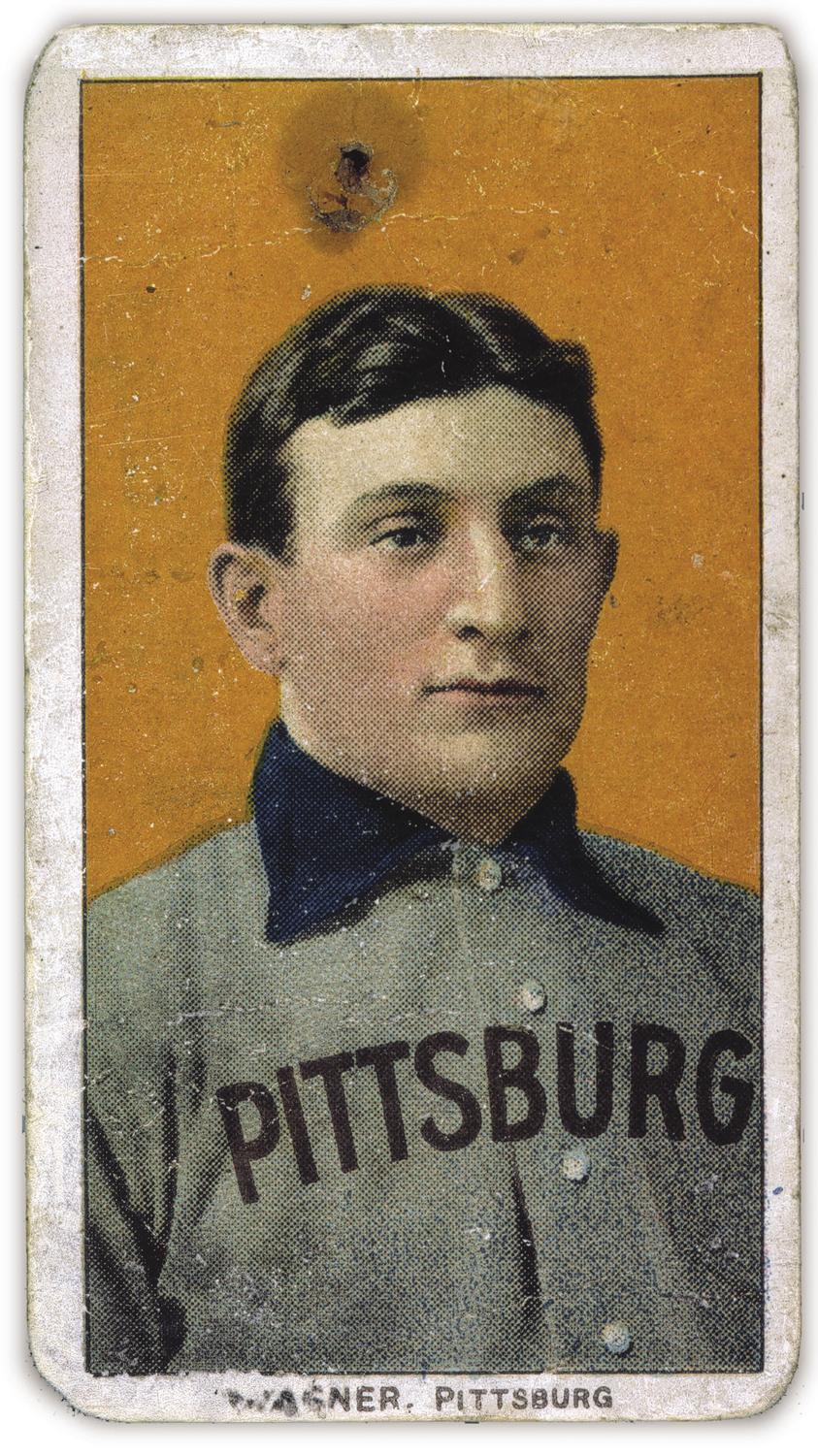
Photo: National Baseball Hall of Fame and Museum
I'm sitting here now at a different library than the one I'm used to. This one is practically across the street from Borders, so I can quickly go there to work on my paper when the library closes. I am enough of a literary freak to really appreciate libraries, and different places to write in general. The best I've ever been in is the New York Public Library in Manhattan, which is beautiful beyond description and even owns not one, but two (!) Honus Wagner T206 cards. One of them was pasted to a piece of paper a long time ago, and each time I see that one I want to scream. What a waste!
But I digress. This library is better, but worse. They are on guard for all things liquid, so my iced coffee resides behind the reference desk. The guy next to me has his in his cubicle with him, but I won't turn him in. Not that kind of guy. But they wouldn't even let me put it on the big table behind me. I'm clearly over it. These cubicles, though, are very cool because they have three plugs built into the left corner of each one, so I don't have to trail my Mac's cord across a room to plug it in. My cubicle seems to be the main one, too, because there is also a large surge protector beneath it, in case I had 27 more things to plug in. This cubicle also has a shelf just above those plugs, and the desk of the cubicle itself is big, so that the whole situation is very convenient. Nice!
I also noticed that there are a ton of books about the Middle Ages, and even some that are encyclopedias of everyday life of various eras. How cool is that?!? So I know where to come and research for the chapters of the past for my plague novel (research for much of it you will find in previous blog posts, below). This area is also relatively quiet, especially now that the buffaloes behind me are gone. They had been playing loud games on the library computers and, after pausing, talking loudly about them, like they were in their 80s and wearing hearing aids. Why didn't the coffee police speak to them? Never mind, I'm over it. Clearly.
The paper is going well. I found a story by Chekhov and one by Munro that both contain the following things: remote location (this works literally and figuratively); thoughtful and reflective characters; a sudden kiss by an unexpected person; epiphanies caused by the kiss; a bridge at the end (also effective for literal and figurative purposes--and structural ones, too); minor characters who do not think or reflect as often or as deeply; minor characters who do not seem to suffer--or to be as aware--because of this; and overall examples of the everyday and their ordinary characters' responses to these everyday things. I have so much, in fact, to comment on, and to cite, that I might not have the space for a Carver comparison after all. Fine with me. We'll see.
Subscribe to:
Posts (Atom)