Showing posts with label Franklin. Show all posts
Friday, September 30, 2016
Alternative Histories
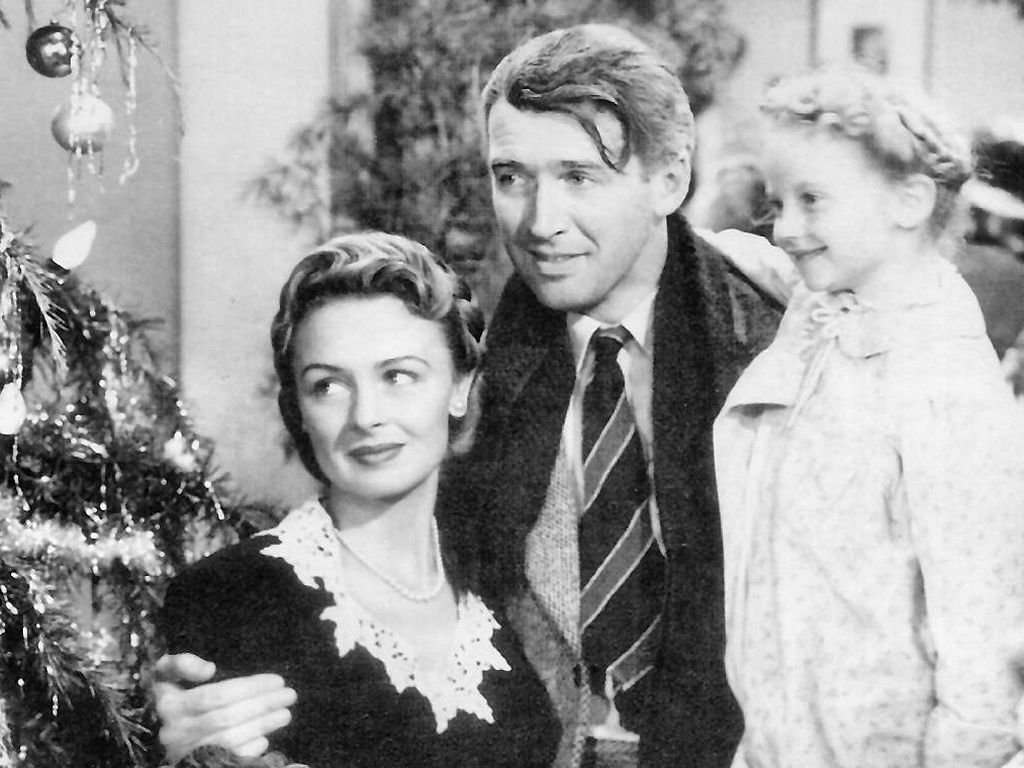
Photo: National Telefilm Associates. But you knew this was Jimmy Stewart, Donna Reed and "Zuzu" from It's A Wonderful Life, right?
This is kind of a review of a book of eleven short stories in the alternative history genre, but it's also kinda not...
I started reading this book because I needed to learn the genre, in case I should need a touch of it for my current novel. I may, but if I do, I'll look to the likes of "A Christmas Carol," or It's A Wonderful Life, which are essentially of the same genre. The first is a story of what Scrooge's life would be like if he doesn't change. In essence, he creates an alternate history by changing, as his dream advises. In the latter, George Bailey witnesses an alternate history of his town if he hadn't been born. They're both inventive and useful (if not life-affirming) exercises, if nothing else. Maybe I'll write each of those some time, just as morning pages.
By the way, an excellent example of this is Ray Bradbury's "A Sound of Thunder," which is the genesis of the phrase "the butterfly effect." In this one, a hunter goes back to the Jurassic--via a time machine and a company that brings you back, tracks a dinosaur that's about to die soon anyway, and puts a red mark on it so you know what to shoot. The catch: Do not step off a hovering path they lay out. If you do, you may step on a plant that was supposed to feed the animals that were a descendant of present-day buffalo, which supplied everything for many Native Americans...you get the idea. (That was my example.) So of course the guy steps off the path and steps on a butterfly. They return to their present that is now very different...Very worth your time.
Anyway, the eleven stories here are largely unimpressive. Mostly they're not stories; they're an actual history--like from a dossier, or a history book--of what would've happened if Benjamin Franklin had created the steam engine (there'd be flying machines in the Civil War and Crazy Horse would've flown them for the different U.S.) or if the French Revolution had ended differently. You get the idea. The complaint here is that most of them weren't stories; they were inventive--and sometimes over-inflated--histories told too factually that seemed of interest to the writer, but weren't to me. There just wasn't story. Seven of them struck me this way--7 out of 11. That's too many. And they were so long that I just skimmed them.
The better ones had story. A plot. For example, Napoleon is your irritated, and irritating, next-door neighbor. You feel bad for him because he's dying, and because he's unhappy that he hadn't climbed to a higher position than lowly lieutenant in the French army: "The Curfew Tolls." Or, you're the bomber pilot who doesn't drop the bomb on Hiroshima. You get tried for treason. Can you convince them you did the right thing? That's the best one: "The Lucky Strike." Or, the South wins the Civil War. The North stays the same, but the south is taken over by the suddenly-free slaves. But they fight amongst themselves, can't agree on a universal language from Africa (because they came from so many different countries and tribes), and the south falls to shambles and is about to be attacked again by the north. And the story starts with a Silent so crazed with his life that he literally beats his head against the wall nine times before he dies. Now that's a story! The very good "Hush My Mouth." There are some good parts of one or two more, but...
So this one should mostly be a pass, though the ones I liked I liked so much that you may want to check this out of your library and peruse the ones I recommend. It's a different genre; but some of the stories in this book are better thought about than read. But the ones I liked were very good.
BTW, speaking of alternative histories, and this is truly a sign of the times: An anthology is in the works now of an alternative (and, by definition established by the genre, worse) America if Trump becomes President. The website says it's receiving a lot of good, horrifying stories. Think Back to the Future 2.
Sunday, February 20, 2011
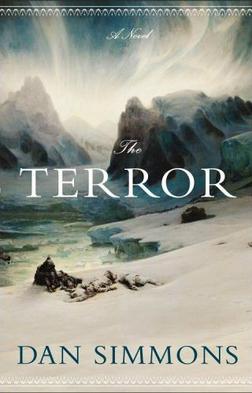
The Terror
Photo: Cover of the novel's first edition, from its Wikipedia page
I've beat the Dan Simmons drum before, with the recently-read Drood. That book had been very good; for a look at my review on this blog, go here. But now, let's talk about The Terror.
This book is much longer, and much more brilliant. At 955 very thin, paperback pages, the most brilliant thing about The Terror is that, with the resolution not in doubt--the back, and associated blurbs, tell you that the whole of Sir John Franklin's expedition died while looking for the non-existent Northwest Passage. If you don't read the backs of books, you probably Google interesting things, and no one will read 955 pages in one sitting. So you Google it, or go to Wikipedia, and you find out that all of the men aboard died of scurvy, starvation, frostbite, gangrene, and poisoning from the ill-prepared cans of food, and that most of the bodies were never found. You know that Franklin's spirited wife, Lady Jane Franklin, who had more money than he did, sent expeditions herself looking for his, all of which mostly failed. You know that there were some graves found later, and some information in cairns, and the Erebus burned and sank at a given spot, and the Terror burned and sank at a spot about 90 miles from where it should've been, and that one man was found frozen on a small boat in the ice--and that's all you know. But the fact that all the men perish is known from the outset.
So, the brilliance of The Terror is that all 955 pages are still compulsively read. It's a rare thing that you're reading a page-turner even though you know how it all ends. But such is the case. Part of its greatness is that it works a metaphor that combines the fact that life itself is a non-winning struggle ("No one here gets out alive," Jim Morrison once intoned), and that the lives of the men is a non-winning struggle, and that the reading of the book itself is in many ways that same struggle. We all know how all three of them end, and it's not for the best, and yet you read on like you fight on, because reading can be addictive like life itself, and what else are you gonna do?
Like all good historical fiction, it makes you want to read about the real thing. When I do, I'll bet that I'll find that Dan Simmons exhaustively researched the real thing--his acknowledgements and souce listings are extensive, though in paragraph format and not in bibliography--and then creatively connected the dots as he went through the real thing. A fictional connect-the-dots of the documented evidence, and of the most learned research and the most educated guesses.
The title itself refers to many things: the main ship itself, of course; the struggle of this existence (referenced many times); death, or Death, and the afterlife, if any; and, most menacingly, a real/mythical super-powerful creature that's basically Predator-on-ice--a gigantic creature with impossible strength that blends in with its surroundings so well you don't see it until it's upon you (or until you see its black, little beady eyes, like a camouflaged octopus). Simmons is smart enough to know that you can't have a novel surviving on just this creature alone, especially when you're reconstructing actual events (and there's no mention of this creature, of course, in the actual events).
The writing is therefore smart as well. It jumps between a dozen or so POVs, sometimes the same one in consecutive chapters. It creates mysterious characters and things--Lady Silence (who the readers, especially the males, will find mysteriously awesome); Crozier's dreams; foreshadowings and almost-prophecies; and the creature, and a mythical/mystical/existential story and belief system that surrounds it--and allows one to live with it. (I'm not sure I buy this last part--the last 20 pages or so of the novel--but it is effective and interesting.) Simmons creates tension with simple bad guys, the elements, the creature, starvation, the accidental poisoning of the cans (and the Royal Navy's cheapness that allows for the instant rotting of much of the canned food), the social atmosphere of the time, the life of seamen in Her Majesty's Service, the whiteout conditions and screwy weather of the area. And, of course, the ice. Oh, my, the ice. The wind. The cold. You'll believe you're there, in the ice, wind and cold--and if you live in Canada or New England this winter (or, from what I understand, in Oklahoma and much of the Plains for a week or so this winter), you almost were there. But these men dealt with -100 degree (yes) weather almost every day. Often it was -30. Towards the end, it approached 0 and it felt like a heat wave.
Did you know that your own clothing could freeze to you if you sweat from exertion, and then it got very cold? Or even if you sweat from exertion or fever while it was very cold? Did you know that you can freeze to death and yet get sunburned at the same time? Amazing.
Read this book. It is impressive. If you're a mystery writer, it is so good that you'll want to emulate it.
Labels:
Canada,
Dan Simmons,
Drood,
England,
Franklin,
Her Majesty,
historical fiction,
Jim Morrison,
mystery,
New England,
Northwest Passage,
Oklahoma,
POV,
Predator,
the plains,
The Terror,
Wikipedia
Subscribe to:
Posts (Atom)