Whoa, it's been a little while! The writing and research of The Gravediggers have been going so well that, with the job to pay The Man and the possibility of my moving into a bigger and better house also taking up my time, something had to give, and blogging was it. I'm at the part in the ms. now where I had to know a little bit about one of my main characters, and as this is historical fiction--my first foray into this genre--I had to research a bit, and get it right. I needed something about the real guy--but not too much!--that I could grab on to, and I got it. Several pictures (with my new phone, thank you very much), several internet articles, and a couple of actual book chapters later, I've got my man. I've got his two main residences, his movin' up in the world, his education background, and a bit of his mindset and reputation. Not too bad, huh? Things going well at the job and on the house search as well.
How about you, guys?
Showing posts with label historical fiction. Show all posts
Showing posts with label historical fiction. Show all posts
Saturday, May 14, 2011


Sunday, February 20, 2011
The Terror
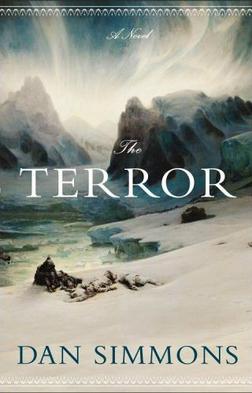
I've beat the Dan Simmons drum before, with the recently-read Drood. That book had been very good; for a look at my review on this blog, go here. But now, let's talk about The Terror.
This book is much longer, and much more brilliant. At 955 very thin, paperback pages, the most brilliant thing about The Terror is that, with the resolution not in doubt--the back, and associated blurbs, tell you that the whole of Sir John Franklin's expedition died while looking for the non-existent Northwest Passage. If you don't read the backs of books, you probably Google interesting things, and no one will read 955 pages in one sitting. So you Google it, or go to Wikipedia, and you find out that all of the men aboard died of scurvy, starvation, frostbite, gangrene, and poisoning from the ill-prepared cans of food, and that most of the bodies were never found. You know that Franklin's spirited wife, Lady Jane Franklin, who had more money than he did, sent expeditions herself looking for his, all of which mostly failed. You know that there were some graves found later, and some information in cairns, and the Erebus burned and sank at a given spot, and the Terror burned and sank at a spot about 90 miles from where it should've been, and that one man was found frozen on a small boat in the ice--and that's all you know. But the fact that all the men perish is known from the outset.
So, the brilliance of The Terror is that all 955 pages are still compulsively read. It's a rare thing that you're reading a page-turner even though you know how it all ends. But such is the case. Part of its greatness is that it works a metaphor that combines the fact that life itself is a non-winning struggle ("No one here gets out alive," Jim Morrison once intoned), and that the lives of the men is a non-winning struggle, and that the reading of the book itself is in many ways that same struggle. We all know how all three of them end, and it's not for the best, and yet you read on like you fight on, because reading can be addictive like life itself, and what else are you gonna do?
Like all good historical fiction, it makes you want to read about the real thing. When I do, I'll bet that I'll find that Dan Simmons exhaustively researched the real thing--his acknowledgements and souce listings are extensive, though in paragraph format and not in bibliography--and then creatively connected the dots as he went through the real thing. A fictional connect-the-dots of the documented evidence, and of the most learned research and the most educated guesses.
The title itself refers to many things: the main ship itself, of course; the struggle of this existence (referenced many times); death, or Death, and the afterlife, if any; and, most menacingly, a real/mythical super-powerful creature that's basically Predator-on-ice--a gigantic creature with impossible strength that blends in with its surroundings so well you don't see it until it's upon you (or until you see its black, little beady eyes, like a camouflaged octopus). Simmons is smart enough to know that you can't have a novel surviving on just this creature alone, especially when you're reconstructing actual events (and there's no mention of this creature, of course, in the actual events).
The writing is therefore smart as well. It jumps between a dozen or so POVs, sometimes the same one in consecutive chapters. It creates mysterious characters and things--Lady Silence (who the readers, especially the males, will find mysteriously awesome); Crozier's dreams; foreshadowings and almost-prophecies; and the creature, and a mythical/mystical/existential story and belief system that surrounds it--and allows one to live with it. (I'm not sure I buy this last part--the last 20 pages or so of the novel--but it is effective and interesting.) Simmons creates tension with simple bad guys, the elements, the creature, starvation, the accidental poisoning of the cans (and the Royal Navy's cheapness that allows for the instant rotting of much of the canned food), the social atmosphere of the time, the life of seamen in Her Majesty's Service, the whiteout conditions and screwy weather of the area. And, of course, the ice. Oh, my, the ice. The wind. The cold. You'll believe you're there, in the ice, wind and cold--and if you live in Canada or New England this winter (or, from what I understand, in Oklahoma and much of the Plains for a week or so this winter), you almost were there. But these men dealt with -100 degree (yes) weather almost every day. Often it was -30. Towards the end, it approached 0 and it felt like a heat wave.
Did you know that your own clothing could freeze to you if you sweat from exertion, and then it got very cold? Or even if you sweat from exertion or fever while it was very cold? Did you know that you can freeze to death and yet get sunburned at the same time? Amazing.
Read this book. It is impressive. If you're a mystery writer, it is so good that you'll want to emulate it.
Tuesday, February 15, 2011
Very Important and Well-written Historical Fiction--The Name of the Rose by Umberto Eco
Genius on every page, one of those classics that will live forever in those who read it. The first historical fiction I read; made me want to do it myself. Gets you caught up in Roger Bacon, etc., whether you're normally nerdy like that or not. Total immersion in the time. The mystery itself is well-told, as well. The best thing about it is that the core of the mystery is inherent on the era, the beliefs, and the superstitions of the people alive at the time. Some very strong things to say about freedom, censorship, and the importance of BOOKS! Yes! And not just the reading of them, which anyone with a screen of any kind can do today. The impetus here is on ownership, on the freedom to read, to know for oneself. There are so many good, fundamental issues covered here that I cannot go into them all without seeming like a blubbering fool, but suffice it to say that it covers the issues of its time in a very non-preachy way, and the reader understands that the issues addressed are not just for that time, but for all times.
Books. Ideas. Freedom. Access to knowledge. (Remember that back then only those involved with the Church could read at all, and only the churches, monasteries and universities had access to books--outside of the very rich, of course.) The right to learn. The right to know. The right to learn on your own, because only those with the books and the ability to read them have access to information, and only those people could dispense that information--as they saw fit--to everyone else.
Very important book. Superior wit, intelligence and skill on every page. Read this one, no matter what genre you normally like. If any of the above issues are important to you--or if you just like a very intelligent read--you owe it to yourself to get this book and read it. It'll stay with you.
Monday, February 14, 2011
Historical (Mystery) Fiction Done Well--Iain Pears' An Instance of the Fingerpost
An Instance of the Fingerpost
Before this, the only historical fiction I'd read was Eco's The Name of the Rose--also a great book. This one is slightly better: It made me feel like I was physically in every scene. Really immerses you into the time. The four different POVs are also ingenuously used. This one made me want to write an historical novel--a task I am not yet up for. Maybe someday...Actually, I'm trying to do a couple now.
An ingenuously written book that has much to teach writers--or would-be writers--of the genre.
1. Totally immerse your reader into the time by describing everything to the point where the reader feels he's in every scene, as mentioned above. This is impossibly difficult because you don't want to bog the reader down with detail, detail, detail; that'll stop the plot from moving foreward and bore your reader. Yet, you can't sustain the suspension of disbelief for over 700 pages if you don't. So how does one toe that line? I don't know, but I DO know that the answer is in this book. I'd have to read it again, with the eye of a writer this time.
2. The time described has to be made interesting, in of itself. Otherwise, why get immersed in it? The era here is fascinating: England, Protestants vs. Catholics. The Papists. The monarchy. The spies. The battle between the starkly divided social classes. It's all here.
3. The mystery has to be riveting enough to continue reading about. Immersion takes work for the reader, too. The writer has to prove to the reader that it'll be worth his while. This one is simple: What happened to the girl? Some guys love her; some guys hate her. The latter actually hate her because they love her, and the power she has over them.
4. The writing itself has to be very good, and very interesting. This one is told from 4 different POVs, each one taking up hundreds of pages, each one an interesting charcater, each one variously unreliable. You care about each one, even the very unlikeable one. And the Truth that shuffles them all together is exemplified by the final narrator, in the final pages--with a last, lasting mystery on the last page.
Once again I am seeing more and more that I should be learning from what I'm reading, and not just enjoying what I'm reading. The Name of the Rose sort of gave birth to Iain Pears' An Instance of the Fingerpost, and it's difficult--and perhaps unnecessary--to tell which one is better. They're both great.
Next post will be on Umberto Eco's The Name of the Rose.
Happy Valentine's Day, everyone, and don't forget to check out my previously unpublished short story, and the prologue and Chapter One of my own mystery novel, at my website.
Subscribe to:
Posts (Atom)