Showing posts with label Drood. Show all posts
Sunday, April 19, 2015
Another Sherlock Holmes -- The Fifth Heart by Dan Simmons
Photo: Book's front and back cover, from kernelscorner.com.
A good Dan Simmons book, though not one of his best (Drood and The Terror are that), The Fifth Heart has a lot going for it, and not too much against it--depending on the reader's level of patience and tolerance.
It's a lot of things, perhaps too many. It's a thriller in a potboiler vein--like Conan Doyle's work. (He's often mentioned but never seen.) It's a mystery of rich people's manners and mannerisms--a la Henry James, perhaps the book's main character. It's a mystery of deduction and induction--a la Sherlock Holmes, the book's other main character. It's a historical adventure, like Simmons' Drood and The Terror.
But--and here's where the reader's patience and tolerance comes in--it's also a pseudo-metaphysical work, one that has the characters very self-aware, and pondering their reality: Are they themselves, or are they characters? The one failure of all this to me is that the characters remain surprisingly productive and un-neurotic despite these philosophical quandaries. We know that Holmes is a character, but the conceit of the novel is that he is not: He's a real person, and so is Dr. Watson. Arthur Conan Doyle is nothing more than the editor of Dr. Watson's unfortunately melodramatic scribblings of Sherlock Holmes's adventures. (Conan Doyle and Watson--both never seen--get a lot of verbal abuse from the many characters.) The reader has to swallow this.
The reader is also forced to swallow the occasional interruptions of a first-person I / omniscient-writer narrator who never fully shows himself. Is it Simmons? Conan Doyle? Watson? Or someone else entirely? It's never definitively shown; the question, in fact, is shied away from. But we, the reader, are supposed to wonder about it, which seems to be the purpose: to cause philosophical wonder. This is a drastic break of the fourth wall / suspension-of-disbelief, and so it needs the reader's tolerance.
This last bit struck me as unnecessary. The philosophical ponderings of existence, of character / person, of reality, and of unreality are all over this book, so we don't really need the intrusive first-person narrator break. It's too much.
Another unwanted intrusion is the much-more-rare Dan Simmons statements. This single-handedly ruined Flashback, which was really just one long Dan Simmons diatribe. He really tones it down here. But you can catch a few times that he elbows his character aside for a moment so he can speak directly to the reader. The most blatant of these was when Simmons makes his characters talk about the Pledge of Allegiance that apparently came from the 1893 Chicago World's Fair. Simmons actually makes a character ask if anything interesting came of a certain meeting between characters. That question is answered by bringing up the Pledge. Another character says how barbaric it is to make students say it, and Holmes himself says that making them do so is something that would happen in Germany. This is a constant Simmons break: He says something disparaging about the American education system as often as he can, in any book. And so he does here.
However, at the end, this book is a good distraction--which Simmons himself seems to realize, as he constantly has characters refer to badly-written but entertaining mystery-thrillers, clearly referring to himself and to his own book. This book, like its characters, is very, very aware of itself. Dan Simmons is always hovering in the shadows over every page, his tongue in his cheek, pleasantly aware and happy about his own literary magic trick.
If you have the tolerance to handle these breaks--which are not as avant-garde as Simmons seems to think they are--then chances are good you'll enjoy the book. It is as meticulously researched as Simmons's historical novels always are, often to the point of approaching info-dump. The characters are amusing, though distinct--so much so that you'll wonder why their married or friendly with each other. The characters had all been real people, and they all get knocked around a bit verbally by the other characters and by Simmons himself. Samuel Clemens, John Hay, Conan Doyle, President Cleveland, and especially Henry James all get some chiding, some of it quite heavy. You'll learn more than you'd probably want about the 1893 Columbian Expedition (read Erik Larson's book about that, too), about the horse-drawn carriages of the time, about Mark Twain's foolish financial disasters, and about train schedules.
It all works somehow, and you'll feel like you're really there. Whether you're able to get back there after the author intrusions and first-person fourth-wall breaks is a big question. I was able to again suspend my disbelief, but only mostly, and only barely, while watching for the next unwanted and unappreciated break of that wall. It didn't ruin it for me, but I could understand how it might for somebody.
I still recommend that you try.
Labels:
1893,
book,
Chicago,
Cleveland,
Conan Doyle,
Dan Simmons,
Dr.,
Drood,
fourth wall,
henry james,
Mark Twain,
mystery,
president,
Samuel Clemens,
Sherlock Holmes,
The Fifth Heart,
The Terror,
thriller,
Watson,
writer
Sunday, February 20, 2011
The Terror
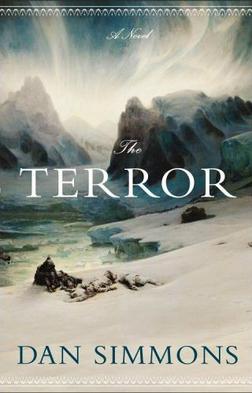
Photo: Cover of the novel's first edition, from its Wikipedia page
I've beat the Dan Simmons drum before, with the recently-read Drood. That book had been very good; for a look at my review on this blog, go here. But now, let's talk about The Terror.
This book is much longer, and much more brilliant. At 955 very thin, paperback pages, the most brilliant thing about The Terror is that, with the resolution not in doubt--the back, and associated blurbs, tell you that the whole of Sir John Franklin's expedition died while looking for the non-existent Northwest Passage. If you don't read the backs of books, you probably Google interesting things, and no one will read 955 pages in one sitting. So you Google it, or go to Wikipedia, and you find out that all of the men aboard died of scurvy, starvation, frostbite, gangrene, and poisoning from the ill-prepared cans of food, and that most of the bodies were never found. You know that Franklin's spirited wife, Lady Jane Franklin, who had more money than he did, sent expeditions herself looking for his, all of which mostly failed. You know that there were some graves found later, and some information in cairns, and the Erebus burned and sank at a given spot, and the Terror burned and sank at a spot about 90 miles from where it should've been, and that one man was found frozen on a small boat in the ice--and that's all you know. But the fact that all the men perish is known from the outset.
So, the brilliance of The Terror is that all 955 pages are still compulsively read. It's a rare thing that you're reading a page-turner even though you know how it all ends. But such is the case. Part of its greatness is that it works a metaphor that combines the fact that life itself is a non-winning struggle ("No one here gets out alive," Jim Morrison once intoned), and that the lives of the men is a non-winning struggle, and that the reading of the book itself is in many ways that same struggle. We all know how all three of them end, and it's not for the best, and yet you read on like you fight on, because reading can be addictive like life itself, and what else are you gonna do?
Like all good historical fiction, it makes you want to read about the real thing. When I do, I'll bet that I'll find that Dan Simmons exhaustively researched the real thing--his acknowledgements and souce listings are extensive, though in paragraph format and not in bibliography--and then creatively connected the dots as he went through the real thing. A fictional connect-the-dots of the documented evidence, and of the most learned research and the most educated guesses.
The title itself refers to many things: the main ship itself, of course; the struggle of this existence (referenced many times); death, or Death, and the afterlife, if any; and, most menacingly, a real/mythical super-powerful creature that's basically Predator-on-ice--a gigantic creature with impossible strength that blends in with its surroundings so well you don't see it until it's upon you (or until you see its black, little beady eyes, like a camouflaged octopus). Simmons is smart enough to know that you can't have a novel surviving on just this creature alone, especially when you're reconstructing actual events (and there's no mention of this creature, of course, in the actual events).
The writing is therefore smart as well. It jumps between a dozen or so POVs, sometimes the same one in consecutive chapters. It creates mysterious characters and things--Lady Silence (who the readers, especially the males, will find mysteriously awesome); Crozier's dreams; foreshadowings and almost-prophecies; and the creature, and a mythical/mystical/existential story and belief system that surrounds it--and allows one to live with it. (I'm not sure I buy this last part--the last 20 pages or so of the novel--but it is effective and interesting.) Simmons creates tension with simple bad guys, the elements, the creature, starvation, the accidental poisoning of the cans (and the Royal Navy's cheapness that allows for the instant rotting of much of the canned food), the social atmosphere of the time, the life of seamen in Her Majesty's Service, the whiteout conditions and screwy weather of the area. And, of course, the ice. Oh, my, the ice. The wind. The cold. You'll believe you're there, in the ice, wind and cold--and if you live in Canada or New England this winter (or, from what I understand, in Oklahoma and much of the Plains for a week or so this winter), you almost were there. But these men dealt with -100 degree (yes) weather almost every day. Often it was -30. Towards the end, it approached 0 and it felt like a heat wave.
Did you know that your own clothing could freeze to you if you sweat from exertion, and then it got very cold? Or even if you sweat from exertion or fever while it was very cold? Did you know that you can freeze to death and yet get sunburned at the same time? Amazing.
Read this book. It is impressive. If you're a mystery writer, it is so good that you'll want to emulate it.
I've beat the Dan Simmons drum before, with the recently-read Drood. That book had been very good; for a look at my review on this blog, go here. But now, let's talk about The Terror.
This book is much longer, and much more brilliant. At 955 very thin, paperback pages, the most brilliant thing about The Terror is that, with the resolution not in doubt--the back, and associated blurbs, tell you that the whole of Sir John Franklin's expedition died while looking for the non-existent Northwest Passage. If you don't read the backs of books, you probably Google interesting things, and no one will read 955 pages in one sitting. So you Google it, or go to Wikipedia, and you find out that all of the men aboard died of scurvy, starvation, frostbite, gangrene, and poisoning from the ill-prepared cans of food, and that most of the bodies were never found. You know that Franklin's spirited wife, Lady Jane Franklin, who had more money than he did, sent expeditions herself looking for his, all of which mostly failed. You know that there were some graves found later, and some information in cairns, and the Erebus burned and sank at a given spot, and the Terror burned and sank at a spot about 90 miles from where it should've been, and that one man was found frozen on a small boat in the ice--and that's all you know. But the fact that all the men perish is known from the outset.
So, the brilliance of The Terror is that all 955 pages are still compulsively read. It's a rare thing that you're reading a page-turner even though you know how it all ends. But such is the case. Part of its greatness is that it works a metaphor that combines the fact that life itself is a non-winning struggle ("No one here gets out alive," Jim Morrison once intoned), and that the lives of the men is a non-winning struggle, and that the reading of the book itself is in many ways that same struggle. We all know how all three of them end, and it's not for the best, and yet you read on like you fight on, because reading can be addictive like life itself, and what else are you gonna do?
Like all good historical fiction, it makes you want to read about the real thing. When I do, I'll bet that I'll find that Dan Simmons exhaustively researched the real thing--his acknowledgements and souce listings are extensive, though in paragraph format and not in bibliography--and then creatively connected the dots as he went through the real thing. A fictional connect-the-dots of the documented evidence, and of the most learned research and the most educated guesses.
The title itself refers to many things: the main ship itself, of course; the struggle of this existence (referenced many times); death, or Death, and the afterlife, if any; and, most menacingly, a real/mythical super-powerful creature that's basically Predator-on-ice--a gigantic creature with impossible strength that blends in with its surroundings so well you don't see it until it's upon you (or until you see its black, little beady eyes, like a camouflaged octopus). Simmons is smart enough to know that you can't have a novel surviving on just this creature alone, especially when you're reconstructing actual events (and there's no mention of this creature, of course, in the actual events).
The writing is therefore smart as well. It jumps between a dozen or so POVs, sometimes the same one in consecutive chapters. It creates mysterious characters and things--Lady Silence (who the readers, especially the males, will find mysteriously awesome); Crozier's dreams; foreshadowings and almost-prophecies; and the creature, and a mythical/mystical/existential story and belief system that surrounds it--and allows one to live with it. (I'm not sure I buy this last part--the last 20 pages or so of the novel--but it is effective and interesting.) Simmons creates tension with simple bad guys, the elements, the creature, starvation, the accidental poisoning of the cans (and the Royal Navy's cheapness that allows for the instant rotting of much of the canned food), the social atmosphere of the time, the life of seamen in Her Majesty's Service, the whiteout conditions and screwy weather of the area. And, of course, the ice. Oh, my, the ice. The wind. The cold. You'll believe you're there, in the ice, wind and cold--and if you live in Canada or New England this winter (or, from what I understand, in Oklahoma and much of the Plains for a week or so this winter), you almost were there. But these men dealt with -100 degree (yes) weather almost every day. Often it was -30. Towards the end, it approached 0 and it felt like a heat wave.
Did you know that your own clothing could freeze to you if you sweat from exertion, and then it got very cold? Or even if you sweat from exertion or fever while it was very cold? Did you know that you can freeze to death and yet get sunburned at the same time? Amazing.
Read this book. It is impressive. If you're a mystery writer, it is so good that you'll want to emulate it.
Labels:
Canada,
Dan Simmons,
Drood,
England,
Franklin,
Her Majesty,
historical fiction,
Jim Morrison,
mystery,
New England,
Northwest Passage,
Oklahoma,
POV,
Predator,
the plains,
The Terror,
Wikipedia
Sunday, January 30, 2011
Drood: What Is Good Mystery Writing?
Photo: Charles Dickens
See below for the 5th and last part of my short story, "Shadows." I hope everyone's liked it. I have been away for a few days; an immediate family member has been diagnosed with an advanced form of cancer--in five different areas. This is bad enough, but there's also a major deadline at work: tons of things due this coming week. Of course.
So what does one do when faced with all this? He escapes! He reads! I finished Dan Simmons' Drood--all 771 pages of it. It's taught me a few things about mystery writing, and maybe writing in general (I warn that there may be some spoilers below):
1. It starts with a quick introduction by the narrator (Wilkie Collins) and the main mystery of the whole 771 pages. Why did Dickens perform a "murder" of one of his characters that so engaged--and horrified--his pre-Victorian audience? This was apparently opposite his normal character.
2. Did Dickens murder someone? The method is explained in one sentence. Very specific detail.
3. Did Dickens become obsessed with a person/thing named Drood? (Avid readers will know that Dickens was in the middle of a masterwork when he died, titled The Mystery of Edwin Drood.)
4. The main settings are described in very specific detail--good writing, never boring--by the end of page 2.
5. The style, tone and mood of the narrator are established by then as well.
6. The famous Staplehurst train wreck that Dickens was a part of about 5 years before he died is used as a springboard for the whole novel, and is very well-written and well-used. This starts on page 3 and ends on page 11.
In short, this bestselling novel does what mysteries should do, what agents want mystery manuscripts to do: it poses the mysteries immediately. It advances very interesting questions that readers would want answered: Did Dickens kill someone? What was that Drood business? It sets Dickens up as the focus of the novel, despite Collins being the narrator--which astute readers will realize as another point. Collins should be the main character of Collins' narration/memoir; he is, perhaps, but Dickens is definitely the focus. This establishes another huge theme: Dickens overshadowing Collins in life, as in this "memoir." Again, this is established immediately and solidly by page 11.
Main characters; main themes; main settings; main mysteries; main questions--in short, everything, established in the first few pages, and then springboarded tremendously well using the train accident Dickens was in--with his young mistress and her mother, by the way, and not with his wife. By page 11, the reader wonders a ton of interesting things and has no choice but to read on.
Agents have mentioned this time and time again. Do this, and do this well, and they will represent the work and it will get published. Dan Simmons had 771 pages to work with--and an already-impressive bestselling status--so he could have done whatever he wanted, at whatever pace he wanted. He still did all of this by the first 11-15 pages.
It isn't selling out. It's good writing.
See below for the 5th and last part of my short story, "Shadows." I hope everyone's liked it. I have been away for a few days; an immediate family member has been diagnosed with an advanced form of cancer--in five different areas. This is bad enough, but there's also a major deadline at work: tons of things due this coming week. Of course.
So what does one do when faced with all this? He escapes! He reads! I finished Dan Simmons' Drood--all 771 pages of it. It's taught me a few things about mystery writing, and maybe writing in general (I warn that there may be some spoilers below):
1. It starts with a quick introduction by the narrator (Wilkie Collins) and the main mystery of the whole 771 pages. Why did Dickens perform a "murder" of one of his characters that so engaged--and horrified--his pre-Victorian audience? This was apparently opposite his normal character.
2. Did Dickens murder someone? The method is explained in one sentence. Very specific detail.
3. Did Dickens become obsessed with a person/thing named Drood? (Avid readers will know that Dickens was in the middle of a masterwork when he died, titled The Mystery of Edwin Drood.)
4. The main settings are described in very specific detail--good writing, never boring--by the end of page 2.
5. The style, tone and mood of the narrator are established by then as well.
6. The famous Staplehurst train wreck that Dickens was a part of about 5 years before he died is used as a springboard for the whole novel, and is very well-written and well-used. This starts on page 3 and ends on page 11.
In short, this bestselling novel does what mysteries should do, what agents want mystery manuscripts to do: it poses the mysteries immediately. It advances very interesting questions that readers would want answered: Did Dickens kill someone? What was that Drood business? It sets Dickens up as the focus of the novel, despite Collins being the narrator--which astute readers will realize as another point. Collins should be the main character of Collins' narration/memoir; he is, perhaps, but Dickens is definitely the focus. This establishes another huge theme: Dickens overshadowing Collins in life, as in this "memoir." Again, this is established immediately and solidly by page 11.
Main characters; main themes; main settings; main mysteries; main questions--in short, everything, established in the first few pages, and then springboarded tremendously well using the train accident Dickens was in--with his young mistress and her mother, by the way, and not with his wife. By page 11, the reader wonders a ton of interesting things and has no choice but to read on.
Agents have mentioned this time and time again. Do this, and do this well, and they will represent the work and it will get published. Dan Simmons had 771 pages to work with--and an already-impressive bestselling status--so he could have done whatever he wanted, at whatever pace he wanted. He still did all of this by the first 11-15 pages.
It isn't selling out. It's good writing.
Monday, January 17, 2011
We're All Characters for Someone Else's Fiction
Photo: Grave of Wilkie Collins, from his Wikipedia page.
As I read books of real-life people from the past--both non-fiction and historical fiction--I've been wondering lately how the descendents of these real-life characters feel about how they're being portrayed. For example:
--In Undaunted Courage, Meriwether Lewis is depicted as a manic-depressive, or, at best, a sometimes-unreliable depressive and melancholic. This is as of page 300 or so. I know that later the book will tackle his really violent suicide, and I know that the author, Stephen Ambrose, will go into greater detail about how Thomas Jefferson wrote about Lewis' manic depression; about how his father and other family members suffered from it, and showed characteristics of it; about how Lewis tended to shun socializing, sometimes, but at other times was a manic socializer; and about how his moods, frankly, ran the gamut from A to B in just a few days. As great an outdoorsman as he was, he is depicted as, honestly, a bit of a nut when he wasn't exploring. He was uncontrollably impulsive in everything--especially financial and emotional--when he wasn't exploring; when he was exploring, he was as meticulous and reliable and thorough--and brilliant--as one can be. Very resourceful when in the middle of the Missouri River, or the Rocky Mountains, but he often couldn't function normally in the middle of society.
How could his descendents, if any, be taking this? Isn't it absurd, in a way, that we must bear a thought not only of how we are to be perceived in our own lifetime, but also hundreds of years afterwards? His outrageous suicide will be described for all the world to see. The most personal, in some ways, of all acts, will be the least personal thing about him when the book is fully read. And before we say that we are not as famous as he, and so don't have to worry, I should point out that his exploring companions are also mentioned by name. More than one was a deserter (It was considered an army expedition, so they were technically AWOL, brought up on charges and put on trial by Lewis and Clarke, etc.) They drank too much; got lusty for the female Native Americans; were at times cowardly; at others, gossipy. You get the idea. All for the world to see, including their descendents. And they are important to no one in the literary world outside of Stephen Ambrose. Yet, on this expedition, we know all about them.
In Dan Simmons' Drood, we learn that Dickens and Wilkie Collins unabashedly cheated on their wives all the time. Dickens lusted after a girl younger than half his age; Collins is constantly described as piggish, and overweight, and full of himself, and he lusted after everyone, especially widows and prostitutes. He says he had a light meal, and that meal is described as a feast for five or more--but it was "a light meal" to him. So he was overweight and didn't seem to know it. He was unreliable in terms of his own character, and his own weight. All this took place just 140 years ago; there's surely someone of his lineage alive today. What could they be thinking? And who's Wilkie Collins outside of literary enthusiasts today? The Moonstone, anyone?
I looked up all of the things these two were said to have done in the real world, and it's all true. Their characterizations are not made up for the sake of selling copies. I take a little umbrage against this today because it already seems as if nothing is ever private anymore. Someone can type something bad about you, and post it, and it's on the internet forever. Numbers we call, people we email, sites we go on--everything has an electronic trail and is forever if it's electronic. (Detectives call it our electronic fingerprint, just as we have an environmental fingerprint in terms of the energy we use, and a consumer or economic fingerprint in terms of the goods that we purchase and/or consume.)
We are all characters for someone else's fiction--now, and 140 years from now. That's always been the case--"All the world's a stage," after all, and Shakespeare said that circa 1600, over 410 years ago--but that has never seemed more the case than it is today.
My gorge rises at it. Though I myself have never done anything so wrong to worry about it, we're all far from perfect, and it's the point of the thing. That's my biggest misgiving of historical fiction and nonfiction: Even the best-written of them contain elements of the unforgiveably slanderous "unauthorized" biographies.
As I read books of real-life people from the past--both non-fiction and historical fiction--I've been wondering lately how the descendents of these real-life characters feel about how they're being portrayed. For example:
--In Undaunted Courage, Meriwether Lewis is depicted as a manic-depressive, or, at best, a sometimes-unreliable depressive and melancholic. This is as of page 300 or so. I know that later the book will tackle his really violent suicide, and I know that the author, Stephen Ambrose, will go into greater detail about how Thomas Jefferson wrote about Lewis' manic depression; about how his father and other family members suffered from it, and showed characteristics of it; about how Lewis tended to shun socializing, sometimes, but at other times was a manic socializer; and about how his moods, frankly, ran the gamut from A to B in just a few days. As great an outdoorsman as he was, he is depicted as, honestly, a bit of a nut when he wasn't exploring. He was uncontrollably impulsive in everything--especially financial and emotional--when he wasn't exploring; when he was exploring, he was as meticulous and reliable and thorough--and brilliant--as one can be. Very resourceful when in the middle of the Missouri River, or the Rocky Mountains, but he often couldn't function normally in the middle of society.
How could his descendents, if any, be taking this? Isn't it absurd, in a way, that we must bear a thought not only of how we are to be perceived in our own lifetime, but also hundreds of years afterwards? His outrageous suicide will be described for all the world to see. The most personal, in some ways, of all acts, will be the least personal thing about him when the book is fully read. And before we say that we are not as famous as he, and so don't have to worry, I should point out that his exploring companions are also mentioned by name. More than one was a deserter (It was considered an army expedition, so they were technically AWOL, brought up on charges and put on trial by Lewis and Clarke, etc.) They drank too much; got lusty for the female Native Americans; were at times cowardly; at others, gossipy. You get the idea. All for the world to see, including their descendents. And they are important to no one in the literary world outside of Stephen Ambrose. Yet, on this expedition, we know all about them.
In Dan Simmons' Drood, we learn that Dickens and Wilkie Collins unabashedly cheated on their wives all the time. Dickens lusted after a girl younger than half his age; Collins is constantly described as piggish, and overweight, and full of himself, and he lusted after everyone, especially widows and prostitutes. He says he had a light meal, and that meal is described as a feast for five or more--but it was "a light meal" to him. So he was overweight and didn't seem to know it. He was unreliable in terms of his own character, and his own weight. All this took place just 140 years ago; there's surely someone of his lineage alive today. What could they be thinking? And who's Wilkie Collins outside of literary enthusiasts today? The Moonstone, anyone?
I looked up all of the things these two were said to have done in the real world, and it's all true. Their characterizations are not made up for the sake of selling copies. I take a little umbrage against this today because it already seems as if nothing is ever private anymore. Someone can type something bad about you, and post it, and it's on the internet forever. Numbers we call, people we email, sites we go on--everything has an electronic trail and is forever if it's electronic. (Detectives call it our electronic fingerprint, just as we have an environmental fingerprint in terms of the energy we use, and a consumer or economic fingerprint in terms of the goods that we purchase and/or consume.)
We are all characters for someone else's fiction--now, and 140 years from now. That's always been the case--"All the world's a stage," after all, and Shakespeare said that circa 1600, over 410 years ago--but that has never seemed more the case than it is today.
My gorge rises at it. Though I myself have never done anything so wrong to worry about it, we're all far from perfect, and it's the point of the thing. That's my biggest misgiving of historical fiction and nonfiction: Even the best-written of them contain elements of the unforgiveably slanderous "unauthorized" biographies.
Thursday, January 13, 2011
Two Books and A Rejection
A few quick things about what I'm reading:
Undaunted Courage
It is amazing what these guys could do in the outdoors. Make cabins, make canoes, hike thousands of miles, ride the rapids, cross the Rocky Mountains and the Bitterroot Mountains, make peace with the Native Americans they found, document every new species of animal and plant, coordinate their location by the stars, write all this in their journals, kill all their food, skin and cook all their food, cure the sick and injured--and face their fears of the unknown. All of this, for years. Away from their families and friends. Despite all this, Meriwether Lewis, after conquering all of these obstacles, after camping on the Pacific, took a look at his life and didn't like what he saw. Said he hadn't accomplished enough, done enough for the general good. Considered himself a failure. (Stephen Ambrose, the dedicated author, concludes that Lewis had been a manic-depressive.) I cannot imagine this; I'm proud of myself when I walk a few blocks with my greyhound. There probably aren't a hundred people in the country today who could do what Lewis and Clark and their men did. I'm almost 300 pages in.
Drood
Author Dan Simmons has created an already-moody (after just 30 pages) telling of the last few years of Charles Dickens' life, as told to us in an unpublished document penned by contemporary author (and still known amongst English majors) Wilkie Collins. Very atmospheric, and shockingly good writing. A very memorable scene in the beginning: It's well-known that Dickens was in a train wreck five years or so before he died, and that his much-younger mistress and her mother--and not his wife--were with him on the train. He got out of the carnage mostly unscathed--although headaches, backaches, and what we know now are PTSD-related symptoms dogged him the rest of his life--but the people he saw and tended to would remain with him, buried undead in his psyche, until he died. The description of these people, and their severed arms, sliced-open heads, fractured skulls--and the mysterious Drood (who could've whispered his name as "Dread"), who was but a shadow with a long black cape, two slits in a skull that passed as his nose, and razor-sharp little teeth--was extremely well-done and clearly in my head as I type this. It is this writing, this atmosphere, and this narrative sophistication that helped this novel sell well and become Dan Simmons' breakout work. (Though his previous, The Terror, also garnered great reviews.)
I recommend both of these books highly. I usually read one non-fiction and one fiction work at the same time. You're not always in the mood to read just one type all the time, right?
Upon my research today, I came upon these two tidbits from two separate agents' websites:
--Query with SASE...No snail mail.
--Prefers to read material exclusively...Only responds if interested.
And I received the shortest rejection ever just under an hour ago: "Not for me--thanks anyway."
Undaunted Courage
It is amazing what these guys could do in the outdoors. Make cabins, make canoes, hike thousands of miles, ride the rapids, cross the Rocky Mountains and the Bitterroot Mountains, make peace with the Native Americans they found, document every new species of animal and plant, coordinate their location by the stars, write all this in their journals, kill all their food, skin and cook all their food, cure the sick and injured--and face their fears of the unknown. All of this, for years. Away from their families and friends. Despite all this, Meriwether Lewis, after conquering all of these obstacles, after camping on the Pacific, took a look at his life and didn't like what he saw. Said he hadn't accomplished enough, done enough for the general good. Considered himself a failure. (Stephen Ambrose, the dedicated author, concludes that Lewis had been a manic-depressive.) I cannot imagine this; I'm proud of myself when I walk a few blocks with my greyhound. There probably aren't a hundred people in the country today who could do what Lewis and Clark and their men did. I'm almost 300 pages in.
Drood
Author Dan Simmons has created an already-moody (after just 30 pages) telling of the last few years of Charles Dickens' life, as told to us in an unpublished document penned by contemporary author (and still known amongst English majors) Wilkie Collins. Very atmospheric, and shockingly good writing. A very memorable scene in the beginning: It's well-known that Dickens was in a train wreck five years or so before he died, and that his much-younger mistress and her mother--and not his wife--were with him on the train. He got out of the carnage mostly unscathed--although headaches, backaches, and what we know now are PTSD-related symptoms dogged him the rest of his life--but the people he saw and tended to would remain with him, buried undead in his psyche, until he died. The description of these people, and their severed arms, sliced-open heads, fractured skulls--and the mysterious Drood (who could've whispered his name as "Dread"), who was but a shadow with a long black cape, two slits in a skull that passed as his nose, and razor-sharp little teeth--was extremely well-done and clearly in my head as I type this. It is this writing, this atmosphere, and this narrative sophistication that helped this novel sell well and become Dan Simmons' breakout work. (Though his previous, The Terror, also garnered great reviews.)
I recommend both of these books highly. I usually read one non-fiction and one fiction work at the same time. You're not always in the mood to read just one type all the time, right?
Upon my research today, I came upon these two tidbits from two separate agents' websites:
--Query with SASE...No snail mail.
--Prefers to read material exclusively...Only responds if interested.
And I received the shortest rejection ever just under an hour ago: "Not for me--thanks anyway."
Wednesday, January 12, 2011
James Joyce, Ernest Hemingway--and Dan Simmons
A friend of mine is leaving Sunday to go overseas for a few months, so he and I hung out for awhile tonight. Where would two writers hang out on a Tuesday night with the salt and sand trucks haunting the roads and with both guys short on money? Borders, of course! Since his birthday is Saturday, I figured, Why not get him some books and then go out to dinner? So what do you get an educated guy who's passionate about literature and writing? James Joyce's Ulysses, the granddaddy of literate, educated, passionate writing. C'mon, it took a landmark obscenity judgment in 1933 to allow its distribution in the U.S. at all, and the last 30 pages is one sentence--and much of that is the evocation of a young woman's stream-of-consciousness and lustful thoughts. (One wonders if it would have been as big a deal had it been a man's lustful thoughts.)
Then I heard he'd never read Joyce before, so I got him Joyce's Dubliners, too. I have to admit that the real treat of that volume is the short story, "The Dead." As brilliant as Ulysses, in a much more compact and different way. The last image of snow and ash-like substance is genius. Lastly, because he'd never read Hemingway's short stories before, I bought him a complete collection of Hemingway's short stories, the Lingua Vica Edition, or something close to that. A friend of mine, who works there, sang the praises of "The Killers," and mentioned its obvious effect upon Quentin Tarantino, which is a leap I will also take. I preferred "Hills Like White Elephants," which my friend said was horribly overrated. He was denounced by another friend of mine who works there. This latter friend is the husband of my 6th grade teacher, because this state is like that.
After buying him these classics, I bought myself Dan Simmons' Drood, and another, earlier book by Simmons. All of this cost me under $20 because I used my better half's 33% coupon, plus a 15% coupon I found in my wallet from a survey I did for Borders, plus another 15% coupon I found as I was leaving the house. I took the survey for that one and used it just in the nick of time. The remainder was paid for by a $30 gift e-card from a friend of mine--Thanks, F.!--and the final tally for me was under $20. I hope to have the time to read these two books sometime in the next 9 months.
Then I heard he'd never read Joyce before, so I got him Joyce's Dubliners, too. I have to admit that the real treat of that volume is the short story, "The Dead." As brilliant as Ulysses, in a much more compact and different way. The last image of snow and ash-like substance is genius. Lastly, because he'd never read Hemingway's short stories before, I bought him a complete collection of Hemingway's short stories, the Lingua Vica Edition, or something close to that. A friend of mine, who works there, sang the praises of "The Killers," and mentioned its obvious effect upon Quentin Tarantino, which is a leap I will also take. I preferred "Hills Like White Elephants," which my friend said was horribly overrated. He was denounced by another friend of mine who works there. This latter friend is the husband of my 6th grade teacher, because this state is like that.
After buying him these classics, I bought myself Dan Simmons' Drood, and another, earlier book by Simmons. All of this cost me under $20 because I used my better half's 33% coupon, plus a 15% coupon I found in my wallet from a survey I did for Borders, plus another 15% coupon I found as I was leaving the house. I took the survey for that one and used it just in the nick of time. The remainder was paid for by a $30 gift e-card from a friend of mine--Thanks, F.!--and the final tally for me was under $20. I hope to have the time to read these two books sometime in the next 9 months.
Subscribe to:
Posts (Atom)