Showing posts with label tower. Show all posts
Thursday, October 19, 2017
Gwendy's Button Box by Stephen King and Richard Chizmar
Photo: from its Goodreads page
More a morality tale / fairy tale than novel (or novella), and a lot more Chizmar than King, but still an okay read that goes by fast. Since it's more of a fairy story, the characterizations are purposely light, the action is more to learn from than to entertain, and it's all supposed to be a slight breeze. To expect more is to be disappointed.
The ending didn't work for me, as it's more explanation than resolution. Richard Farris (AKA, Randall Flagg) will disappoint, as he seems like someone kinder than we know him to be. Here, he's more like the old man from Hearts in Atlantis than the badass from The Stand and The Dark Tower. He should've been called someone else here, with different initials. He's really a different character. In this way, he's more of a disappointment than is the talky, explanatory ending itself, but the book is so slight that you really won't mind. Like all morality tales, the ending is explained too much and is too completely wrapped up. I would've rather had something extra left over to think about, but that won't happen here. Is it more Gwendy, the box, or just life itself? You'll be told, which is a bummer. Should've been left more open-ended.
And, lastly, you won't see anything Dark Tower-ish here. Mr. R.F. and the box are just extras stepping out. You won't be able to place them within the Dark Tower's milieu, so don't try. There's no leftover strand, or beam, and those worlds don't influence this one in this book. If you want a standalone book that has tendrils and whispers of The Dark Tower, check out King's The Wind Through the Keyhole, which was quite a bit better, and released to very little fanfare. That one is a Dark Tower rejected section or chapter if I've ever seen one.
So you'll have to take this book on its own purposely slight merits, and judge them by those. I think it's pretty clear to see where King starts off and Chizmar takes over. This would've been darker, more ponderous and a lot less slight if King had written a bigger chunk of it. My guess is that King started it, maybe the first two or three chapters, and included the kite scene and maybe a hat scene or two, but let Chizmar take it. My guess is he figured The Wind Through the Keyhole was one Dark Tower standalone enough, and he didn't need another one. I'm guessing Chizmar stayed as far away from The Tower as he could. Perhaps he was asked to.
This one was more of a curiousity for me. I don't consider it part of the King canon and I won't be buying one for my entire First Edition Stephen King book collection. My copy was from the library, where it will return tomorrow. So if you want a quick little book / morality tale that's maybe 20% King, max, give this one a shot. It's not bad, but it's not King. If you have other King books that you need to get to, you're probably better off doing that.
Labels:
%,
Atlantis,
book,
collection,
edition,
fairy tale,
fantasy,
first,
hat,
Hearts in Atlantis,
judge,
kite,
library,
Randall Flagg,
Richard Chizmar,
Richard Farris,
Stephen King,
The Dark Tower,
the stand,
tower
Saturday, June 17, 2017
The Quest for Mary Magdalene by Michael Haag -- Book Review and Brief Comments
Photo: from books.google.com at this link
Extremely readable history of Mary Magdalene, from the Bible to Dan Brown, that will teach you some things even if, like me, you've read a lot about her already, from the likes of Vermes, Ehrman, etc. For example, you probably know that nobody in the Middle East of this time had first and last names. Jesus of Nazareth was the Nazarene. John the Baptist, was, well...You get the idea. No one had last names. So it's also been known for awhile that Mary Magdalene was called that like Jesus was called Jesus the Nazarene. As he was a Nazarene, from Nazareth, she was the Magdalene, from Magdala. Well, not so fast there. Michael Haag, author of this book, posits that there was no Magdala at the time we're talking about, from 1 to 33 A.D. (or CE, if you will). (Except in Matthew 15:39, where after feeding the multitudes Jesus took ship to Magdala. But a Codex much older than the copy we have in use in our present Bibles [You know the Bible is thousands of years old and has been copied, and miscopied, millions of times, yes?] known as the Codex Vaticanus has the same village in that passage as Magadan, not Magdala. So why the last name? Haag says she was known as "the Magdala" (like John was "the Baptist") and that the word comes from the Aramaic (the language Jesus spoke) magdal and the Hebrew migdal--and that these words mean "tower." Like, how shepherds had a tower that they could use to see the miles of fields where the sheep grazed. Sound familiar? As Jesus said he was the shepherd who watched over his sheep, or flock, meaning his disciples and believers today, so too did somebody watch over Him. That, apparently, is the nickname (and Jesus did give a lot of nicknames, as he did to most of the disciples) Jesus gave to Mary Magdalene. She was the Tower. She watched over him.
Photo: St. Peter, from Catholic.org.
No wonder Peter didn't like her. Peter wasn't Peter's real name. His real name was Simon. Peter is a nickname Jesus gave to him because it means Rock. And he was the first Pope, essentially, as he was "the rock" that the Church was founded upon. But now that you understand the thing about nicknames, which Jesus gave out like he gave out parables, well, now, it makes you think, right? No wonder Peter complained about Mary Magdalene all the time.
[The book lags a little in the last few chapters as Haag embarks on a quick trip through present day renditions of Mary Magdalene. Feel free to skip those. It's a little better when it describes Mary Magdalene in paintings from the Renaissance and the Middle Ages, though I think it worked for me more because I'm interested in those times, and not so much because of what Haag had to say about Mary Magdalene in those times. It's at its best when it covers the Bible and the gnostics--ironic, because Haag describes himself as more of a historian on the Templars and Crusades, and not so much as a biblical scholar. But that's where he's at his best here.]
Haag's research is exhaustive and he deals a lot in common sense--things you would think go hand in hand with historians, but that hasn't been my reading experience. Often they're either too much one or the other, but they need to be combined to make sense of something that happened thousands of years ago. Haag does that well with the Bible. For example, after I thought I'd read everything there is to read about Mary, the mother of Jesus, I see this:
"There are indeed hints in the gospels that stories were going round in the lifetimes of Jesus and of Mary his mother saying that he was a bastard and she was an adultress. 'Is not this the carpenter, the son of Mary, the brother of James, and Joses, and of Juda, and Simon? [A]nd are not his sisters here with us?' says Mark 6:3. In Judaism a son would be identified by naming his father even if Joseph had been dead for a long while, but Mark, who mentions every other member of the family, leaves Jesus' father unknown. Nor does Mark mention Joseph in any other part of his gospel. And in John 8:41 during a confrontation at the Temple[,] the Pharisees say to Jesus, 'We be not born of fornication', insinuating that he was."
Photo: from Pantera's Wikipedia page at this link. "Tiberius Julius Abdes Pantera (c. 22 BC – AD 40) was a Roman soldier whose tombstone was found in Bingerbrück, Germany, in 1859."
I just looked those passages up again in my New Testament. Mine replaces Joses with Joseph, and Juda with Jude, but all the rest is the same. And you can't disagree with the logic Haag uses. I've known all the stories before: I don't believe there was a census, because at no other time in the history of the world has a leader told his people that, for a census, everybody had to pack up and move back where their original ancestors came from. Can you imagine that happening in America today? What a nightmare! And the story of the slaughtering of the firstborn? No other writers writing at the time--and even in antiquity, there were many--mention anything like that. You would think it would make headlines, that everyone would have a comment to say about it, even someone in a court, in his private diary, never mind actual historians (apparently there have always been historians translating history, even in ancient history). But nobody did, outside of that one biblical passage, Matthew 2:1-16. So, yeah, I'd already known and thought about that, [and just click here in my blog so you can read about my thoughts of Mary and Pantera], but this was the first time my attention was drawn to that one passage, of Jesus, "the son of Mary." Of course Haag is right. From ancient times, in the Middle East, in the Nordic stories, in Beowulf, in the Odyssey, possibly all over, a man is defined as being the son of his father, not the son of his mother. Beowulf and Odysseus were referred to like that long after their fathers had died. But when the father is unknown? Or the man had been born out of wedlock, for whatever reason?
Photo: from Pantera's Wikipedia page at this link.
Haag shows some good research and some good common sense, in equal measure. (And I have to add that, for a very long time, I've been put off by Jesus's only biblical conversation with his mother, at the wedding at Cana, in John 2:1-5. Yes, she seems to have been nagging him, but he is still rather curt and annoyed with her. No other writer has mentioned the same slight surprise at this that I have always felt. Until now. So thanks, Mr. Haag. Just a little thing, but it bothered me. And how do we feel about that conversation being the only one between Jesus and his mother? Doesn't it seem like she's been rather scissored out? Mary, His mother, is venerated now, but she got short shrift then.
And the author proves rather conclusively, I think, that Jesus and his disciples were financially supported by Mary of Bethany, Mary Magdalene (if they're different; many scholars think they're the same, as Haag seems to), Joanna (possibly a former wife of someone relevant in the royal court, a man named Chuza), Mary, Jesus's mother, and a few other loyal women. I've considered this, but not for too long. But, yes, there seems to have been money flowing in, and it wasn't from Jesus himself, right? And his followers were fishermen (who were not necessarily poor at that time, but the Bible says these were) and others said to be destitute, so who had the money? Could the women be hiking all over the Middle East unless they had some money? And the women who were not from money, or who were not married to it, where did they get enough money, in that time, to be financially independent? (Get my, and Haag's, drift here?) But where do the robes come from? The food? The water? The sandals? Over the few years of the biblical stories? The Bible stays rather close-lipped about this, but it makes sense. These things cost money, and the guys didn't have any. Why else would these men, as worried about women as they were (Peter, for example, was apoplectic about them, especially Mary Magdalene; you can look that up), have these women along all the time, but that they were the bank?
Photo: from La Pieta's Wikipedia page at this link
So, yeah, makes you think. And that's why I read books like this. To think very seriously about a book that essentially controls my government right now, and yet none of those guys (and I emphasize the guys) seem to have actually read all of it. (Trump, especially, I assure you, has not. But a caveat: He's never said that he has. In fact, he's not very religious. But the southern gentlemen controlling him are. [The Russians controlling him may be as well.] Or, at least, that's what these fine conservative white men will tell you as they push their agendas along. Believe me, when Trump's impeached, these fine men will cut their strings with him very fast, and then say they never really liked him in the first place, that they had their doubts about him all along.)
Well, anyway, because I believe you have to know and study the weapon of choice of your adversary, I have read every single word of the Bible, Old Testament and New. Yes, every word. Twice. And countless times in close readings while reading books about it. Which is right, by the way, to read books like Haag's and not to just take the author's word for everything. That's part of the whole problem, right? To just take someone's word for something very important without reading it yourself? So I do that--I read the Bible, and I read about the Bible, and then I read the Bible again to better think about the things that I have read in books about the Bible.
Because, for God's sake, someone's got to. See what I did there?
So if you're interested in this kind of thing--and if you're being unfairly controlled by conservative social laws in the U.S., you should be--then you should read this. It says a lot of right, and righteous, things about how women have historically had their importance stripped from them since antiquity. If it can happen to Mary Magdalene, and Mary, mother of God, then it can happen to you, right? Right?
Friday, March 24, 2017
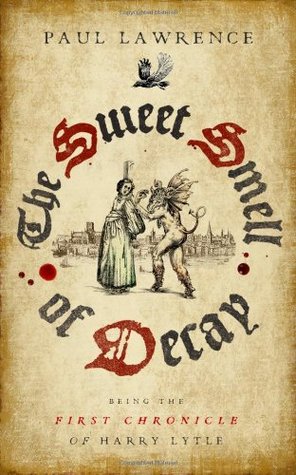
Decay and Disgust in 1664 London -- The Sweet Smell of Decay, a Book Review
Photo: from the book's Goodreads page.
I really liked this book despite its inconsistency. Some parts are very well-written, and some...well, aren't. Very odd. You can get a paragraph or two, or a few pages, with exceptional prose, or description; but then suddenly you get a dead-weight clunker of a paragraph, or sometimes just a line or two. There are shifts in tone, too. Suddenly--and I mean you can hear the screeches--a character becomes shady. Suddenly a scene changes, or you can't see it clearly. Towards the end there's a well-drawn action scene--and then suddenly you're at a trial, and it's very drawn-out. And the main character, Harry Lytle, does this and does that, and seemingly never stops, to do anything, and you realize that can't be, and it all doesn't come together, but it's okay because you're reading about yourself going through the motions as Lytle, and that's enough. In fact, that's the point, and undoubtedly the author's intent.
Very tough to explain.
But despite it all, you have a main character who is likable in his opaqueness. Who is he? What does he do? Not really ever explained, but he's a common enough bloke, and he's supposed to be you, the reader. He's just accessible enough to be us. We're the ones doing what he's doing, seeing what he's seeing. That transition is so seamless, you don't even realize it happened.
1664 London is really the main character, and it is supported well. The mystery isn't really mysterious. (The plot is more of a mystery, if you know what I mean.) It's all explained at the end, not very well, as the bow falls off and isn't neatly tied. But you won't care, because you're there for the sights and sounds of 1664 London, and you will get a lot of that, and you'll like it. The logistics of the ending is a head-scratcher, as are all of the characters when they take off their wigs to check for lice. Everyone's bald, and everything's filthy and gross, and 1664 London is just a disgusting place, where people get hanged but don't die, and their intestines are ripped out and burned and they don't die, and they're then tied hand and foot to horses and ripped apart, and if they still don't die, they're carted in a wheelbarrow to the nearest river and dumped in. And then their heads are stuck on a pike on a bridge or tower. And a prisoner about to die this way soils his pants, and that's described, and you realize that's what you're reading this for--the details, like you're there in 1664 London, and you're happy to be there by reading about it, because you sure as hell wouldn't really want to be there.
That's why this book works. If you like the history of historical fiction more than you like the fiction of historical fiction, you'll like this one. I'm on to the next, A Plague of Sinners.
Labels:
1664,
author,
book,
bridge,
character,
fiction,
goodreads,
happy,
Harry Lytle,
head,
history,
lice,
London,
Paul Lawrence,
plague,
prison,
river,
Sweet Smell of Decay,
tower,
trial
Saturday, July 6, 2013
Black House by Stephen King and Peter Straub
Photo: The book's cover, from its Wikipedia page
This is probably the last of my unread Stephen King books for awhile, in case you were getting tired of my many Stephen King reviews lately. At 625 pages, this one took half a week to read, and much of it was pretty intense. This intensity waned a bit the more it went on; an editor working with two lesser-known names would've done much good here. The second half, and definitely the last third, are very fat. Much could have, and should have, been trimmed there.
But it is still a good ride, especially the first third. It's told in a very third-person omniscient style, and in the present tense, no less. Lots of the word "we," as in "And now we see Jack Sawyer--." That takes a little getting used to, but it's not that bad. It fits, though I can't see why such a different storytelling tactic was necessary. The last third is so fatuous that even this third-person omniscient, present tense POV does not give the narrative a you-are-there feel. It's so in need of editing, that such word-bloat takes away from the intensity the reader is supposed to feel by this narrative POV. You don't get that "Once upon a time..." lean story-telling voice that the authors are clearly going for. (The book even ends with exactly that phrase.)
Having said that, it's worth reading, especially if you're a fan of the The Talisman and/or The Dark Tower books. Black House is situated firmly in the Dark Tower universe, much more so than The Talisman, though by the end of it, you get the feel that it's a story from a minor planet of that universe, so to speak. It is not a major entry in that series; the Dark Tower saga, as it's now complete, can and does exist without this. It's a side-room behind one of the many doors in the Dark Tower's house. It's interesting to open that door and peer in, and see what's there, maybe admire the old furniture and to appreciate the character of the room, but when you shut the door, you can move on to the staircase and to the more important rooms.
Black House can't decide which character it wants to follow. It follows Jack Sawyer more than anyone else, but not like The Talisman did, and when the focused POV of the second half follows a gross old man, a pawn of the Crimson King, it starts getting fat and unfocused. With that character's demise, it then focuses again as it should, upon Jack Sawyer, and then goes a place or two that the reader wouldn't expect--but shouldn't be completely surprised about, either. Stephen King has followed the antagonist before--lately in Under the Dome--and you have to wonder about his main character, his protagonist, if even he decides that his antagonist is much more interesting. The reader had better agree--and this one didn't, in this case. (I did agree with that tactic for Under the Dome.)
But it doesn't work here because the gross old man is still nothing more than a gross (and murderous) old man. The power he has is given to him by the Crimson King and his minions, and so he's nothing more than that. More or less, then, this novel is an examination of the root of evil, of where it comes from. Where does an evil, murdering, pedophile cannibal like Albert Fish (Mentioned very frequently here, and worth a Wikipedia visit--if you can stomach it. No sin if you can't. It's extremely gut-wrenching stuff.) and Charles Burnside (this book's Albert Fish) come from? Well, apparently from another universe, and its evil incarnate, which uses the (less?) evil and the weak here for its own nefarious purposes. All well and good, I suppose, except that this book doesn't present a convincing case for that.
Ultimately, the first third of the book is extremely good. The first half is very good. By three-quarters it starts to wane, and by the end you're ready for the end to end. But it still ends well, and so it is still worth reading--if you can tolerate the fat. I was able to cut it away and dine on the rest. If you can do that, this book is worth the read.
(The parts written by Straub, in my opinion, stand out from those written by King here. My guess is that Straub wrote most of the first half, King most of the second. There are some Straub writing patterns and signatures I recognized, and some from King as well. For example, Straub does not tend to choose his antagonist as a POV focus as King does, and so I feel much of that is King's. Since most of the Charles Burnside focus happens in the second half, I feel that's where King's fingerprints are. The first half, especially, resonates, as all good writing should. The first half sank into my consciousness enough so that I was compelled to write a previous blog entry, two entries ago. Ironic, since most of what I wrote about were Stephen King thematic constructs, though it was Straub's treatment of them in the beginning of this book that compelled me to write about them. But that's art for you.)
Saturday, June 29, 2013
My Beam, My Tower
"There are other worlds than these," Stephen King has Jake say in the first Gunslinger. Or, at least, that's the phrase I hear when I think about it. I sometimes believe this to be so, that there are other worlds than these. Maybe not in a Gunslinger way, nor in a Talisman way, nor even in a Lord of the Rings way.
In what way, then? I don't know, but in this other world I don't grind my teeth, and every pen is as smooth as the one I used to originally write this down. There's a lightness, but also a sense of urgency. In this other world, there is a known magic, an accepted sense of wonder, of awe. Life is simpler, but harder for its simplicity. There's more color, more sound, more vibrancy. More of a Pull.
In this world, here, I get more of a sense of Push than Pull. I feel pushed along, usually roughly, rather than pulled gently, though perhaps inexorably. My mind is calmer when I feel Pulled, than Pushed.
I'm pushed to pay The Man, as we all are, and to do the job that helps me to pay The Man, though I'm fortunate to be both Pushed and Pulled at my job. That's my Beam here, I think. My job. The difference I'm told I've made, and continue to make. That's how I stay on the Beam here; that's my contribution to the Beam, to the Tower that supports us here. Would the Tower tremble without me doing what I do here? I like to think so. Someone recently told me he has done everything he's done because of what I did for him back in the day, maybe nine or ten years ago now. So maybe there's a Beam that connects us, me to him, and both of us to the Tower here. It's always nice to think you matter.
But there, in that mirror world, I think my writing, my creating, keeps the Beam buzzing. The Me, there, lives in a somewhat muted contentedness, alone in a wooden shack, with some of the same things there as here. I write by candlelight and it's always raining outside. I have a small fireplace in a small hearth, but as it's a small room in a small one- or two-room house, and as I'm warm with my sweater and my shawl anyway, it's all good.
Maybe one me also supports the other. A glimpse of me here to the me there, and vice-versa. I look out my office door to the Me in the commode mirror, beside the picture of the younger Me in Amistad, and I can see all this.
In what way, then? I don't know, but in this other world I don't grind my teeth, and every pen is as smooth as the one I used to originally write this down. There's a lightness, but also a sense of urgency. In this other world, there is a known magic, an accepted sense of wonder, of awe. Life is simpler, but harder for its simplicity. There's more color, more sound, more vibrancy. More of a Pull.
In this world, here, I get more of a sense of Push than Pull. I feel pushed along, usually roughly, rather than pulled gently, though perhaps inexorably. My mind is calmer when I feel Pulled, than Pushed.
I'm pushed to pay The Man, as we all are, and to do the job that helps me to pay The Man, though I'm fortunate to be both Pushed and Pulled at my job. That's my Beam here, I think. My job. The difference I'm told I've made, and continue to make. That's how I stay on the Beam here; that's my contribution to the Beam, to the Tower that supports us here. Would the Tower tremble without me doing what I do here? I like to think so. Someone recently told me he has done everything he's done because of what I did for him back in the day, maybe nine or ten years ago now. So maybe there's a Beam that connects us, me to him, and both of us to the Tower here. It's always nice to think you matter.
But there, in that mirror world, I think my writing, my creating, keeps the Beam buzzing. The Me, there, lives in a somewhat muted contentedness, alone in a wooden shack, with some of the same things there as here. I write by candlelight and it's always raining outside. I have a small fireplace in a small hearth, but as it's a small room in a small one- or two-room house, and as I'm warm with my sweater and my shawl anyway, it's all good.
Maybe one me also supports the other. A glimpse of me here to the me there, and vice-versa. I look out my office door to the Me in the commode mirror, beside the picture of the younger Me in Amistad, and I can see all this.
Wednesday, January 30, 2013
Poem Published
Photo: A Florida Box Turtle, from the Wikipedia page for "turtle." (You'll have to read below to get the connection between the title and the pic.)
Just a quick note:
My poem, "An Old Man," (which is not about an old man, per se; it's an extended metaphor, representative of all of us) has been accepted for publication by the good people at Lost Tower Publications, in the U.K. It'll be in an anthology, Hope Springs A Turtle (Get it? Instead of "Hope Springs Eternal?"), and 10% of the proceeds will be donated to Mind U.K., a mental health charity in the United Kingdom. More details here.
The anthology will be available in book form, and as an e-book. I'll send another notice sometime later when the book and e-book are available. It ain't Shakespeare, but at least now I can say I'm a published poet. I've published a short story, a short nonfiction piece, and now a poem. After he mentioned this about me, a friend of mine then said that I'm more versatile than the elastic of his underwear, at which point I murmured "Thanks" and walked away. Ewwwwwwwwwww.......
The publication's website, linked in the last word of the first paragraph, said the poem needs "to invoke the spirit of hope." For those of you who know me, and who are wondering how anyone can construe anything I write as an invocation of hope, I have to say that this one does. I've thought of the poem as a combination of Gloria Gaynor's "I Will Survive," and an old man looking at his burial plot in a snow-covered, wind-swept cemetery. Although even the gravestones themselves are covered by a sheet of frozen, crusted snow, he will do his best to survive, anyway, even if he is cognizant of the fact that we'll all have our own resting place someday, and it'll be unknown to the world, and it won't even be visible to anyone during a snowy winter.
Yeah. Cuz I'm like that. It is hopeful, though, in its own way. Trust me.
Subscribe to:
Posts (Atom)