Showing posts with label America. Show all posts
Wednesday, July 12, 2017
They Lie -- Fake News on the Radio
Photo: Original 1st Edition of the hardcover, from the book's Wikipedia page
One of my (many) personal catch-phrases that I say (perhaps way) too often is: "It's not that I don't really trust anyone, or anything...It's just that I don't really trust anyone--or anything." Occasionally I've wondered if maybe I'm being a little too paranoid or cynical. But then this past week happened. The last 10 days or so have blissfully reinforced my outlook. I've been emboldened, and it seems to me that I'm right, sadly but surely, that everywhere around us are "Lies! Lies!" (Those quotes were for a friend of mine. Those two words are amongst his favorite catch-phrases.)
So here's one of the lies flung at me recently:
1. A radio station commercial that sounds like a newswoman reading a report, but which is actually a commercial for an organization that represents the National Republican Party.
If you're in RI, listen in to B101. (And, no, that's my better half's preferred station, not mine. I don't have a preferred station. I mostly listen to CDs and YouTube.) Anyway, here's what this woman says. In a newscaster's tone, she tells us that 80% believe that the news about Trump and Russia is overblown and that we should all just move on. (This is before we knew that Trump Jr. sold his soul to that devil.) She then says that 75% believe that it is wrong for a foreign leader to mock our president.
But...80% and 75% of whom, exactly? She doesn't say. Now if she'd said the 80% came from 8 out of 10 Republicans polled, I'd believe that. And 80 out of 100. Or 800 out of 1000. Or, hell, even 4 out of 5. That's the number of dentists from that commercial, right? (Watch out for numbers. They don't lie, but they can be manipulated. You ever notice that polls--during ballgames, for example, when they ask a seemingly random and irrelevant question and then tell you to text your answer--are always gauged by percentage and not whole numbers? Because they don't want you to know that only 5 people texted, or only 10 people were polled. So, yeah, 4 out of 5 and 8 out of 10 are 80%, but is that a relevant stat?
Photo: from qz.com, (which got it from the Associated Press), as is the quote in quotation marks:
"This meeting was the one in which Trump gave highly classified information to Russian foreign minister Sergey Lavrov and ambassador Sergei Kislyak."
Another thing: If that woman is saying that 80% of the country--across all political lines--think that we need to move on from this Trump-Russia thing (Notice I didn't use a slash there, like Trump/Russia, because those two really are connected.), then I assure you that's straight-up BS. Lots of Republicans are wary and leery of Trump & Russia, so I'll bet that more than 20% of them would say it needs more looking into. And I double-dog assure you that if even all of the country's Republicans believed the news is "fake news"--which is not the case--then you still need a very high percentage of Democrats and Independents to feel the same way in order to make the 80% stat accurate. Do you honestly think that about half of all Democrats and Independents think that way? That's a "Hell, no!" no matter what your opinion is on the Trump-Russia issue itself.
Why the ad that sounds like a newscast? LIES! That's for the people who believe what they hear (Mistake 1) and who don't think about what they read or hear (Mistake 2) and who then tell others what they hear and relay it as fact when it isn't (Mistake 3).
Who made that ad? Well, who has the most to gain by it? C'mon, isn't that creepy? That's right out of Animal Farm, and it's scary. (And shame on you if you don't know the reference. Animal Farm and 1984 should be required reading right now.) That's shady people working for shady politicians who are shadily using the media (in this case, the radio) to spread falsity and lies to benefit themselves and to give themselves more power. That should frighten and anger you, and if it doesn't, well, that's what they're counting on.
And a fake newscaster saying fake stats like it's news? Yeah--that's literally "fake news," people. And from the very people who swear it's being used against them. These people are slimy. I need to take a shower just having to think about these people. But think I do, and you should, too.
Please let me know if you've heard this ad, or something like it. Share your story.
Next time on "They Lie": furniture mailings that push "interest-free monthly payment options" more than their furniture, and a mortgage company insisting they're holding a really low interest payment percentage for me that's actually higher than the one I already have.
Labels:
&,
%,
1984,
America,
Animal Farm,
Democrat,
devil,
dog,
fake news,
furniture,
Independent,
interest,
lie,
mortgage,
radio,
Republican,
RI,
Russia,
soul,
Trump
Monday, June 5, 2017
Wonder Woman -- A Rant within A Movie Review
Yes, I am a grown man who went to see Wonder Woman Sunday night with my better half. I'm okay with this, for a lot of reasons. I liked it a lot, and I'm going to buy it when I can. Loved, loved, loved this movie. Here's a rant within a review (and here's another, quieter one from Time Magazine, at time.com) to explain why:
I was a little concerned about the hoopla about the movie being shown first to a female-only audience. Notice I'm saying I was concerned about the negative reaction given to the female-only showing, not about the movie itself, nor about the female-only showing. One: the moviemakers can do whatever they want with their own movie. Two: It sort of makes sense that a movie based on a television show (and comic) geared towards the theme of female empowerment should be shown to an audience of females. Three: I'm a little concerned, and tired, of men acting the victim. This is insulting and offensive not only to women, but to common sense and common decency. Men, of course, have been victimizing women since time immemorial, physically, emotionally, psychologically, culturally, and financially, in America and elsewhere; in the workplace, in the paychecks at the workplace, at home, at a debate while literally stalking them on a political stage, and, lately, on a tape with Billy Bush that was heard all around the world before the man speaking on the tape became President because he appealed to hate groups, hateful people, and powerful and computer-savvy Russians. I'm sorry, did I say all that out loud? I did. But enough of that shit, waddaya say? He gropes women, he's obviously assaulted women, he brags on tape about groping women and assaulting women, and occasionally he procreates with women, while insinuating that he'd like to do so with his own daughter, but let's not pretend for a second that he actually likes and respects women, okay? Had enough of that. He wants blatant truth and not political correctness? Well, there it is. Wonder Woman sort of gives an innocent little finger to all that, and it's about time.
Photo: Wonder Woman is not complacent, she's not weak, and she's not French. (Sorry.)
Women have gotten the short end of the political stick lately, so how about we all just shut up as they watch a damn movie, huh? And, funny how even a movie review becomes a sign of these political times, but that's how screwed up and Alice in An Effed-Up Misogynistic Wonderland these times are.
Wonder Woman is a good action movie that, despite itself, says a lot of things, all of them well. And one of the things it says well is that women can be themselves without any shame. (Wonder Woman, unlike all of the other women from her enchanted isle, is not exactly a fish without a bicycle, per se, but she understands that she could be, that loving a man is a choice, not a mandate. [And shame on you if you don't get the reference.]) One of the things I noticed in this action movie--very different from the thousands of action movies I've seen--is that no man in the movie grabs the woman's hand as they run away from something. (Remember how Daisy Ridley correctly griped about this in the latest Star Wars franchise film?) Wonder Woman doesn't have to withdraw her hand from the guy who grabbed it, because no guy keeps up with her and grabs it. She kicks ass (apparently with a hairstylist on immediate standby) and the men have to follow her. She doesn't stop for them. She doesn't wait for them to act. She doesn't wait for them to save her. She doesn't wait for them to save others. She doesn't wait for them to solve ills or even to stop the war. She takes the lead. That they are willing to follow her, literally and figuratively, without any sexist misgivings (these are all incredibly good, well-behaved guys), is a victory in its own right. Yes, she looks better than Kate Beckinsale and Milla Jovovich and Angelina Jolie and Pamela Anderson (showing my age with that last reference) as they're kicking ass in their painfully tight black leather outfits, but that's not why the guys follow her into battle. You'll have to watch the movie to see why, but trust me on this. They follow because of who she is, not because of what she looks like. She is not a What. Perhaps that's a lesson there.
Photo: The picture referenced below, from Wonder Woman and another movie, best not referred to.
Having said all that, Wonder Woman is not a political movie. It doesn't try very hard (it does maybe a little tiny bit) to teach this lesson, or any lesson at all. It's actually a very good action movie. It's directed very, very well. The production design is very good. The script is reasonably intelligent (there's a tiny bit of emotional lovey-dovey crap at the end, which threatened to connect to my one or two feelings, but it gets a pass with me) and it even has a frame story technique. In fact, that involves the one thing--the only one thing--I liked about the last Batman, Superman, Wonder Woman movie monstrosity mess: the picture of her in WWI that Bruce Wayne finds. That picture was the best part of that movie, and I was looking forward to knowing the story behind it. This is it. I wish I could prove this, but I actually said that to my better half, that the picture was the best part of that movie. It's the starting point, and the finishing point, here, and that works very, very well. As I've said to people before: good writing is a frame story, a book-ending, a wrap-around. Good technique. Simple, but effective.
So, anyway, this movie doesn't try to be political. That it is, anyway, is yet another indicator of these incredibly, jaw-droppingly, Can't Believe People Voted for A Guy who Mocked A Handicapped Reporter on Worldwide Television and then Tweets more than a 12-year old black hole we're in.
This movie says we can be ourselves, anyway, even when our immediate environment is going to hell. Be yourself, fight against wrongs, and be strong, and don't wait for someone else to do it. This was an effective, stirring, moving, meaningful action film that looked and sounded great, that guys can enjoy, that, by God, may actually be saying something beyond itself that is true and worthwhile.
Wonder Woman, and Gal Gadot, who plays her, are immigrants, by the way. See what I did there?
Labels:
America,
Angelina Jolie,
Batman,
bicycle,
Bruce Wayne,
Daisy Ridley,
fish,
Gal Gadot,
kate beckinsale,
Milla Jovovich,
Pamela Anderson,
president,
Star Wars,
superman,
woman without a man,
Wonder Woman,
WWI
Monday, March 20, 2017
Caleb's Crossing by Geraldine Brooks -- A Book Review
Photo: cover of the paperback book, from its Google.com page.
Very, very well-written account of a young girl's life on Martha's Vineyard and in Cambridge, Massachusetts in the 1660s. Though the book is more known to be about the first Native American to graduate from Harvard College, it is really about this girl and her Puritan family. Narrated by Bethia, the book is a comparison between her life as an Other, and that of a native Wampanoag named Cheeshahteaumauk, called Caleb by Bethia's family after his Indian family dies of disease, probably smallpox. (He dies of disease, too, of consumption, not long after he became the first Native American to graduate from Harvard College.) This is a book, like all her others, to read and enjoy, and to learn from and emulate if you want to be a writer. I can someday hope to become nearly as good--though that is doubtful--but I cannot become better.
Bethia loves life on the island, despite its hardships. Let me rephrase: She loves the island more than she loves her life on it. Her chores and responsibilities are endless. She loses her parents and her younger sibling, all three in horrible ways. She can read and write and she has intelligence and opinions--all bad in 1660s Puritan Massachusetts, especially on the island. Her daily life, with and without her best friend Caleb, and her family, are equally interesting and distressing to read about.
She follows Caleb and her older brother to Harvard. Her brother is next in line to lead the family and to become a preacher like their father. Except, he's not intelligent, not good in the ways of leadership or human nature. He can't read as well as she, and he can't learn the Bible's languages as well as she. In fact, she's a helluva lot smarter than he is, and they both know it. In fact, Caleb, the "salvage," the other and the lesser in that time, is also smarter than he is in all of these things, and he knows that, too. Despite all this, Bethia goes to Harvard with them because it is her indentured servitude that will pay for her brother's education there, so that he can become more in their society than she can, though everyone knows she deserves it more. She steals a bit of an education while she can, eavesdropping on lessons, learning from the other students, etc., but it is not a life she is destined to overtly benefit from.
In lesser hands, Bethia would fall in love with Caleb, and run away with him, and such, but these are not ordinary hands, and she does not do this. Bethia as a child was confused about her true feelings for Caleb, and maybe she did have what we would call a crush on him for a few years, but overall she outgrows that, and they become perhaps even closer, a brother and sister that would have continued had he not died. She leaves with another man, rather happily, from that Harvard disaster, and lives in Italy for a time, before she comes back and sees Caleb in his final days. The book is told in three parts, the last of which is a bit more sad than perhaps it needed to be, but who am I to judge? It's all enthralling. You'll feel like you're there, and you'll care about everyone.
Brooks clearly is painting a parallel between Bethia's life in 1660s Puritan Massachusetts and that of women in 2000s America. She does this in every work, and continues to do so here. As usual, it is not overt, or heavily done, and you don't feel preached to. This outlook, again as usual, enhances the story and does not detract from it. In fact, that cultural comment is not the story. As always, her story is her story. Bethia and Caleb, two others in a career-long character list of strong others, are her vehicles to tell this story. They themselves are not the story, per se. This is a distinction that all writers trying to say something should understand: your characters tell the story, but your characters are not the story. They drive it, of course; the story is not a river and they the mere floaters. But the story is the tide, and the characters either swim with it, or they swim against it. Brooks is excellent--here, and especially in March, her Pulitzer-winner--at showing the tides of the times she sets her stories in. It is one of the many things she does masterfully.
So this book is a story of the time, but also of our time. There is an other of every time, as we see today. I suspect maybe a female of African-American or Mexican descent is writing a good book about that as I type this.
Labels:
1660s,
America,
Cambridge,
Cheeshahteaumauk,
consumption,
education,
Geraldine Brooks,
Harvard,
Italy,
March,
Martha's Vineyard,
Massachusetts,
Mexican,
Native American,
Pulitzer,
Puritan,
servant,
Wampanoag
Sunday, January 29, 2017
We Are Everyone, From Everywhere. We Do Not Ethnically Cleanse.
Photo: the Lady Liberty posted by Rihanna, Mandy Moore, Jessica Alba, and others after The Ban. From this website via The Daily Mail.
"Give me your tired, your poor,
Your huddled masses yearning to breathe free,
The wretched refuse of your teeming shore.
Send these, the homeless, tempest-tost to me,
I lift my lamp beside the golden door!"
Just not after January 28th, 2017, I guess.
This nation was founded by those escaping religious persecution. Such persecution happens somewhere in the world, every day, and always has. But never before has it happened here.
We are the only nation on Earth that, by our very nature, is a consistently changing population. The population of most countries is predominantly an unchanging group of said peoples. The majority of the population of France is French; in Denmark, the Dutch. But in America, we're everyone, from everywhere. That is the very essence and nature of this country. We are Everyone, from Everywhere.
Let's not change that now. Let's not turn our backs on those who need us now. They're the next Us.
Germany tossed out, and closed its borders, against a certain peoples. That's not what we do. Let's not toss out Muslims, the vast majority of whom are not violent people. Let's not toss out Mexicans and then put up a wall against them.
The Muslim Ban today. The Mexican Wall tomorrow. What's next? When will it end? Is this the start of an American cleansing?
Let's not start this. Let's not do this. This is not who we are. That, is un-American. Literally.
[Please feel free to copy and paste into your social media, without giving credit. Please just share this message and spread the word.]
Friday, December 2, 2016
Support Kellogg's and Fight the Bully
Photo: Eleven, of Stranger Things, from yahoo.com/tv
If you're completely unfamiliar with the situation, first read this article by clicking here.
In a surprising move this week, Kellogg's pulled its advertising dollars from the website of Breitbart News. Many other companies have since followed suit. Breitbart is the ultra-right wing, conservative site that calls itself a "news organization." It's not. It publishes opinion, not fact, and it only publishes one type of opinion, rather than many. News organizations, of course, publish the news, which always involves facts. It also publishes all types of news, not just the type that pushes its own propaganda. The founder of Breitbart, Stephen Bannon, is essentially the man behind the strategy that won Trump the White House, and is destined to be someone of importance in Trump's machine. Think of Bannon as you will, but you can't deny that he has his own super-conservative right-wing agenda, which even Trump at times doesn't agree with.
Whatever.
The main idea of this post is to point out that, for whatever reason, Kellogg's pulled the plug on its advertising dollars on the website, which is more of a blog than a "news source." This is not unusual, as companies frequently pull its advertising from places that they feel don't (or won't) generate as much income, or reach a particular consumer group. Kellogg's insists that the withdrawal is not political, and I'm inclined to believe that. After all, one doesn't advertise on Breitbart to begin with unless one wants to reach white, super-conservative, right-wing readers. This was the case before Trump, and it's certainly the case now. If the withdrawal was political, the ads would never have been there in the first place. And since the site has generated more hits since election day, it makes sense that the company would've kept its ads there.
So what's the reason?
In an article you can read at this link, the point was raised that companies can reach Breitbart's type of readership more effectively via other avenues, such as any website of Glenn Beck's. But the main reason Kellogg's and other companies pulled the plug is because they may not have known that their ads were on the site to begin with. Apparently, ads that we see on the left and right of the screen online are not put there by those companies. They're placed by yet another company that gets paid to put ads on websites where they'll be seen. Since Breitbart's readership has grown, those companies put the ads of Kellogg's and other companies on that website. Some companies, like Kellogg's, and now like Vanguard, 3M and AARP, apparently didn't want to spend their ad dollars there, or they didn't want to reach the readers Breitbart's caters to, or, as Kellogg's said, because Breitbart's "didn't align with their values."
Fair enough. Happens all the time. From the linked article:
While Breitbart is billing Kellogg’s decision as “bigoted and anti-American,” it’s a well-established American business practice for corporations to shift their sponsorship to companies they believe will help bolster their brand. In the case of reaching conservative audiences, advertisers that exit Breitbart aren’t necessarily snubbing those consumers because other conservative-leaning outlets, such as Fox News or Glenn Beck’s The Blaze, have an overlap.
“There are a lot of places advertisers can go to reach the same audience, and even maybe a bigger audience,” Wilkins said.
Hell, I've lost a few blog followers over the years because they may not have liked the thoughts I've espoused here. Whatever. To each his own. If I made money from this blog by putting ads on it (I've been offered many times, but I don't), that would hurt a bit because companies gauge a blog's hits and its numbers of followers when they decide what to advertise on. Blogger, in fact, may place some ads for companies that pay them to do so. If not, another company gets paid to do that, and they in turn probably give a cut to Blogger, since Blogger has an icon that I could insert into this blog which would run the ads that would generate money for me. After that, I get lost.A Vanguard spokesperson maybe explains it better:
Vanguard said it removed its ads as soon as it became aware that they were running on Breitbart. “As a policy, Vanguard does not advertise on any overtly political websites, including the site in question,” a spokeswoman wrote in an email. She said the ads appeared as part of a “remarketing” program, which are ads that appear to clients and investors when they visit third-party websites because of their browsing history.
“Our remarketing advertisements are limited to pre-approved sites (again, no political sites), however it was brought to our attention last week that this site was inadvertently included,” she said.
So the shocking thing here isn't that Kellogg's pulled its ads. The surprising thing is that Breitbart has pushed a boycott on Kellogg's for doing so. That's nuts! That's like me trolling the followers who have left the blog over the years. Won't do that. That's like a newspaper publishing an article against a company that decides not to put ads in that newspaper anymore. Wait--actually, it's not, because a newspaper actually is a news organization that publishes news and facts, and news and facts of different types, like local news, national news, world news, sports, money and finance, etc. Breitbart, which calls itself a "news organization," doesn't do that.Instead, like Trump did, it declares war and attacks those people and businesses they feel have slighted or threatened it.
This is frightening for many reasons. As the linked article said:
Breitbart’s campaign against Kellogg’s is unusual on a number of fronts, not in the least because news organizations traditionally maintain a separation between their business operations and their editors and reporters so that journalists can operate independently from business interests... And whether the boycott will help Breitbart financially appears questionable, given that attacking a major advertiser isn’t likely to make the site more appealing to other brands.
“Reporters don’t behave that way in the U.S., nor should they,” said Lee Wilkins, professor and chair of the department of communications at Wayne State University, who’s an expert in media ethics. “Most journalistic organizations have checks between the people who pay for your news work and the news work itself, so that you are as a journalist protected from those influences.” She said she views Breitbart as a blog rather than a journalistic organization. “If you aren’t a journalism organization, then those safeguards are never in place.”
This is an important distinction. A "news source," which Breitbart isn't, cannot influence its news reporters about what news to print. It can't be seen as a bully to its own reporters, thereby creating a bias about what gets reported and what doesn't. But Breitbart can do that, as it is, solely because it's not a legit news source, but rather more of an opinionated blog. But a business of any kind can't declare war on another business because that company pulls its ads.
It's not personal. It's business. This is yet another example that shows that Breitbart, Bannon and Trump don't get that distinction. Politics and business are not personal. You can't bully and attack those who disagree with you or who don't support you. That's a tyrannical thing to do. In America, we don't bully or declare war on our political enemies, and we do not suppress the news, or only report one type of news story. That's not what a democracy does.
So, in the spirit of democracy, to fight back against the bullies, I suggest that next time you want some cereal, or some breakfast food, buy Kellogg's. Let's support the first company that in a democratic fashion pulled its ads from a very un-democratic site. Let's support the first one brave enough to take a stance.
My better half has Kellogg's Eggo's for breakfast a few times a week, and Eleven loves them. Good stuff.
Sunday, October 30, 2016
A Warning About A Society's Purge and A Book Review
Photo: the paperback's cover, from it's Goodreads page
Vienna Secrets by Frank Tallis is a very good book, #4 in the series, that was nominated for an Edgar Award in 2011. The mystery involves a few decapitated men, all in one way or another seen as enemies of Vienna Jews--the last one also being Jewish himself. There are the typical cast of characters, all of whom seem guilty in some way, until the real murderer shows himself towards the end. Max Liebermann gets out of that mess, solves the crime, solves a male patient's pseudo-pregnancy, and walks out of a meeting with his job--in that order. Once again, Tallis seems to show that the crime is second-fiddle compared to the more normal things his character has to go through.
But the real purpose of this book, as with the first three and the following two (I don't know why I've read them out of order, but it's not proven to be a problem), is to show the growing anti-Semitic dissension in 1903 Vienna. The subject is integral to the plot, to the characters, to everything. The book ends with the sadly ironic statement: "Today, Jews may be insulted and abused, but they will never be consigned to the flames again." This was supposedly written in Dr. Liebermann's journal in Vienna, 1903. Hitler, who was born in Austria on April 20, 1889, and who spent time in Vienna, was 14. Since he moved to Germany in 1913, he could plausibly have been a part of Liebermann's 1903 Vienna, but Tallis apparently decided--wisely--not to go there. But the irony of that sentence is impossible to miss.
I've harped on this before, in my other Tallis / Liebermann reviews, and Tallis himself has harped on this in every single Liebermann book, but I'll harp on it again: These books were written long before this last year's election cycle, but the warning is not subtle:
Beware of the makeup of your society, and beware who rules that society.
A country's leader is a reflection of that society, not the other way around.
A woman-hater, for example, cannot succeed in a society otherwise void of woman-haters. A xenophobe who fears / hates Mexicans cannot succeed in a society that does not otherwise fear / hate Mexicans. Though such an aspiring leader may lose an election by garnering "only" 30% to 40% of the vote, such a percentage is still alarmingly high and must be seriously addressed by that society. Simply put, that's a lot of fear and hate. Even if that aspiring leader goes away, the fear and hate-mongering that he flamed will not. It'll be there, and it could, and probably would, get worse.
It's happened before. Europe, 1890-1945. Spain and England have had Jewish purges. America has had a Native American purge. Think about it: If the current aspirant could wipe out those he hated, would he? Even his allies would say Yes. (In fact, that may be why they're his allies.)
So watch out. Beware of the makeup of your society, and beware who rules that society.
This book shows that was true in 1903 Vienna, and it shows it's true in 2016 America.
Beware. Keep your eyes open.
Labels:
#,
%,
1945,
2016,
America,
anti-Semitic,
book,
England,
Frank Tallis,
Germany,
Hitler,
Jew,
Jewish,
Max Liebermann,
Mexican,
Native American,
purge,
society,
Spain,
Vienna
Saturday, October 29, 2016
Getting It Wrong -- A Clockwork Orange
Photo: from the MSN article linked below. You've got to see this movie. A disturbing masterpiece.
I recently read an MSN photoslide article of 40 movies that critics got completely wrong. (Click that to read it.) Some made me so upset that I had to vent--I mean, blog--about them. For example:
“Stanley Kubrick's 'A Clockwork Orange' is an ideological mess, a paranoid right-wing fantasy masquerading as an Orwellian warning. It pretends to oppose the police state and forced mind control, but all it really does is celebrate the nastiness of its hero, Alex.” — Roger Ebert, Chicago Sun-Times
Of all the movie critics I've read over the years, I agreed with Roger Ebert most. (Though I am most frustrated with his review of Dead Poet's Society, but that wasn't one of MSN's 40 here, so that's a blog for another day.)
But he got this one wrong. (See the movie if you haven't.) A Clockwork Orange is not paranoid right-wing fantasy. That's Trump-land, a country that Kubrick would never consider visiting. Though he had his share of really out-there thoughts (and don't we all), Kubrick did not feel Britian's (which is where he lived, let's not forget) police force was in danger of dominating his country with a tight fist.
It is an Orwellian warning, in a way, but not as criticized here. Certainly Orwell's lesson of "beware of who you elect to control you," and, for that matter, "beware of those who you let control you" is in play here--but that's not what the movie is really about.
A Clockwork Orange says to beware of a totalitarian police state (with the emphasis on the police), but it also says that we do need a large and controlling police presence, because human nature sucks, and left to our own devices, chaos will reign. That's the irony Kubrick was trying to show. Kubrick was all about irony, all the time. And so it is here.
Alex isn't the criminal, the movie says. His society is criminalizing, and he is a criminal as a byproduct. Though Alex is individually responsible for his own actions, the bureaucracy that tries to "civilize" him just makes him worse. This movie is definitely an attack of that bureaucracy. Remember the scenes of the guard transferring Alex? Remember the bureaucratic forms that had to be filled out? Remember how long that took, especially that ingenious shot of the guard separating the perforated portion after that's signed? Who wouldn't be driven to anger or mindlessness in that nihilistic setting of dominant mindlessness? When the bureaucracy is all that matters, we're all lost.
The insinuation here is that we are all Alex, or at least potentially so. So the movie doesn't pretend to oppose the police state. It does oppose the police state--as depicted as a mindless bureaucracy. It's not paranoid at all--often, human nature does suck, and at our core, no matter how much we think we're civilized, we're all still baseless and base. (That was the point of 2001, too. Remember the million-year flashforward bone-flip? Despite all our technology, all our civilizations--on Earth and on the moon--we're still just a base, bone-loving species. Some of us are okay with that, but some of us strive to be more than that, a new species, maybe, capable of so much more.) Burgess's novel somewhat says the same thing, and this movie beats it over our heads.
Since we're all capable of being Alex--some more so than others--we do need a heavy police presence. But too large a police presence (and it's mind control) is just as bad, if not worse, as having too many criminals. So it's bad to have, but we do need it, to some degree. What degree is that? Well, in the movie, it was too much. In the beginning of the movie, it wasn't enough. So where's the line? Kubrick didn't know, and he's saying we don't know, either. Recent events in America since Ferguson show we still don't know. (Art imitates life, right?)
And so the movie doesn't celebrate the nastiness of Alex as much as it uses that behavior to prove its point. In very broad strokes, written large, the movie showcases the all-too-human negative "celebration" of the nastiness in us all. Kubrick (and Burgess) say: We're all potentially that nasty. Which is why mind control and a police body politick aren't the answers. The answer has to come from within us, individually. In only that way can we create a "civilized society," which is a Nietzschean umbrella term that really doesn't exist--another point that Kubrick makes here. The movie is all about that irony, painted with very broad strokes to the point of satire and farce--but, let's face it: Isn't civilization, society, and other umbrella terms all a farce anyway?
Look around you. Look at American politics right now. Look at what we call our civilized society--a culture that actually does celebrate the dehumanization of women, minorities, LGBTs and, really, anyone else who is not a self-satisfied, arrogant, pompous, self-loving rich white male. (We don't seem to understand the difference between self-serving "facts" and actual facts, either.) And, by the way, our American society is still one of the best, most stable ones out there in the whole world.
That's the reality right now. It's that million-year bone flip in 2001: Despite our technology, despite what we call our civilized society, we're all still a bunch of bone-wielding, power-wielding, blood-loving savages. And no matter how we're trying to control ourselves--with prisons, politics or mind-control (and those last two are often the same thing, by the way) we're always going to be like that.
Because we're human, and that's our human nature.
That's not a very negative, twisted farce?
Labels:
2001,
A Clockwork Orange,
Alex,
America,
Anthony Burgess,
book,
Chicago,
Dead Poet's Society,
Ferguson,
movie,
MSN,
Nietzsche,
Orwell,
police,
Roger Ebert,
Stanley Kubrick,
sun,
Sun-Times,
technology
Saturday, October 22, 2016
All (as of 10/16) of Trump's Bullying and Biased Quotes in One Place and with Links 2
Photo: from a Wall Street Journal article about what a "sane Donald Trump" would be like. But, it says, when it comes to Trump ignoring a tally on November 8th that says he lost, "...Does he know he's playing with fire? No. Because he's a nut."
Just like the title says. You can find #1 through #5 at my last blog entry--just click here.
Again, the following quotes come from a recent Washington Post article that outlines its closing statement about the Presidency. Well, as of 10/16, anyway. Each point has its own link back to the article and the appropriate YouTube video, for your reading and viewing convenience. To finish up:
6. "Written by a nice reporter. Now the poor guy. You ought to see this guy." November 24, 2015.
This is Trump mocking and mimicking a physically disabled New York Times reporter. You have to see this to fully appreciate how horrible it was. Click on this link to go to the article, then scroll down to #6 to see the video.
I never thought I would see a candidate for President of the United States mimicking a handicapped person. I'm talking arms flailing, body twisting, stuttering--everything. Again, this is bullying, plain and simple. And it's behavior that, frankly, a President should not have. We're above this, aren't we? By the way, this reporter's crime? He wrote an article negative about Trump. Is this what a grown man does in response to such a thing, mimic and mock another man's physical disability? A teacher wouldn't tolerate this behavior in a classroom, but we'd tolerate this behavior in the President?
This is also unforgivable. We do not mock and mimic those less fortunate than ourselves. And we learn to control our adolescent behavior, especially when we're running for President and speaking to the world. If he can't do that in a press conference for his own campaign, how is he going to be appropriate during a meeting with a leader from the Middle East, or from Russia, that's not going well?
7. "Putin's running his country and at least he's a leader." December 18, 2015.
Putin is also guilty of more civil rights violations than any other Russian leader in recent memory. His critics have a bad habit of mysteriously and permanently disappearing. He is undoubtedly behind the hacking of the Democratic (and probably Republican) Party's computers--and Trump openly suggested that he hack into them again. I can't recall the last time I heard an American politician openly asking a foreign (and possibly antagonistic) leader for aid in bringing down his political opponent--to the point that such an attack would be espionage and a major attack on our government.
This is careless beyond belief. And his cozying up to Putin is gut-churning and worrisome. If Trump is as much of a puppet to Putin as he is to his two (thuggish) sons and to Steve Bannon, then there's something very, very wrong. Even as a candidate, an alliance with Putin is treason, as Trump is right now privy to our nation's secrets and plans. Think about that last sentence for a moment.
8. "I'm going to open up our libel laws." February 26, 2016. AND "This judge is of Mexican heritage. I'm building a wall." June 3, 2016
Besides the obvious racism and bigotry (and isolationism, always a bad thing) of the second statement, what we have here is a classic case of Trump not knowing what he's saying. He would fail a middle school history class. The fact is, he can't, even as President, change any laws or build any walls--especially one that would cost billions and strain an already strained relationship with a neighboring country. Now, understand, he doesn't even mean these things. But even if he did, he has to get both of those policies through Congress, and that's not going to happen. The point is, he doesn't know that. He thinks the Presidency is a tyranny, and he'd be the King. But our democracy is purposely designed so that's not the case. No one person can declare War, or spend billions of federal dollars, or suddenly and drastically change judiciary laws. Congress does the first thing, and the Supreme Court does the last. And there's 9 judges there, and he only gets to place one right now.
Many of his supporters don't know this. Many racist people will vote for Trump because of this wall that he cannot possibly ever put up, and they're as ignorant of that as they are of anything racial.
But we're not. America needs to show it's not racist, and that it's not ignorant of how its own government works. We need to show that a politician cannot use fear, hatred and racism (the three always go together) to win the Presidency.
9. "Look at my African-American over here." June 3, 2016. See above. Need I say more?
10. "I alone can fix it." July 21, 2016.
This is how Fascism can come to America. I used to wonder how a country like Germany, a country that had the most brilliant universities, scientists, philosophers and writers of its time, all in one place, could ignore its intelligence and put someone like Hitler in power.
Now I know. Now I get it. We're one step away from doing that ourselves. I just said that. Out loud.
But so has The Washington Post, The New York Times, USA Today, and even Dubya Bush, for God's sake. (This is the first and last time we'll agree on anything.) Millions, thank God, have spoken out.
But this is how it's done. An egomaniac, a hater, a bully, a tyrant, a Democratic old-lady stage-stalker convinces enough like-minded folks to put him in power and then he does all those crazy things. He says that he is the only one who can fix everything. Him. That's it. The only one. The demi-god. The God-in-his-own-mind. This is what Hitler did. He took a very angry nation, simmering in rage about its defeat in World War One, and he told it that he alone can make everything right again. He gave them someone to fear and hate (Jews) like Trump has (Mexicans and women). Like other tyrants, Trump said that everyone who disagreed with him (political figures, newspapers, television reporters, and even parents of fallen soldiers) were in secret conspiracy against him. And that's why there's no proof, because they're all in secret conspiracy. (Many of his supporters have to believe in secret conspiracies.) According to the latest poll, 40% of the country is like this. (This is scary in of itself.) He riles them all up, appeals to their base emotions and then he bullies everyone else into submission. Those who don't submit--like his political opponents--he threatens to throw in jail, or he threatens violence against them. Sound familiar? Trump has done both against Clinton. That's what other countries do, not us. That's what America has always prided itself in--we don't act like the tyrants of other countries, especially after Election Day. This is the sole reason Ford pardoned Nixon. If elected, with all that power, is it so unreasonable to suggest that Trump would go one small step further and actually do those things he's threatened? His supporters, of course, want this. They want a tyrant.
America and Britain let Hitler do this, even though they knew the danger. I don't see powerful countries sitting by this time and watching that happen. Britain has already banned Trump, and NATO and the United Nations have already passed policies in advance of our election--just in case.
The rest of the world is looking on in horror. Trump would shrug that off, and say that the rest of the world doesn't matter. But it does. Look at history. Look at what happened to countries that elected a tyrant and then isolated itself. Didn't turn out well, either for that country or for the world in general.
I'm not normally like this, especially politically. (I'm not normally that political in general.) I don't normally think the sky is falling. I don't live my life in fear.
But it has come to that. Again, I'm not the only one saying so. And I'm not some moralist, a guy who judges everybody, or someone who thinks you have to be a saint to be President. I voted for Bill Clinton, after all, though I wouldn't want any daughter of mine to date someone like him. But Clinton, for all of his (many) faults [the largest of which was to ignore the Cole attack, by the way], was not a world-wide danger. Countries didn't ban him. He wasn't racist, or bigoted, or a bully. I didn't worry that he knew where our nukes were because I didn't think he'd want to use them. Trump, for Heaven's sake, would use them on Mexico, or perhaps on the next national NOW meeting. (I'm kind of exaggerating there--I hope.)
And that's the problem. I'm not sure I'm kidding. Seriously. The comparisons are too obvious and real to ignore. The examples are too frequent and too crystal clear. He is that much of a hater, a bigot, a racist and a tyrant. The U.S. and the world can probably survive him, but are we totally sure? Do we want to put the world at risk to find out?
Labels:
America,
Britain,
Clinton,
computer,
congress,
Democrat,
Germany,
Hitler,
King,
Mexican,
NATO,
New York,
president,
Putin,
Republican,
Russia,
Supreme Court,
Trump,
Washington,
YouTube
Tuesday, October 18, 2016
All (as of 10/16) of Trump's Bullying and Biased Quotes in One Place and with Links
Photo: Trump (left) and Alec Baldwin (right) from this MSN article about Trump dissing Baldwin.
Each of the following examples has a link to a page that has the YouTube video appropriate to each item. This is from a list from an article outlining The Washington Post's closing statement about Donald Trump's candidacy. The comments, of course, are mine. But click the link to see the YouTube videos. Seeing Trump mimic and mock a physically disabled reporter really has to be seen to be believed.
1. "When you're a star, they let you do it. You can do anything. Grab them by the -----. You can do anything." October 2016
That's the infamous Access Hollywood tape. He called it "locker room talk," but as I've blogged before, it isn't. It's sexual assault talk. The laughter you hear in the tape is Billy Bush, formerly of NBC. He's getting a $10 million buyout from the network--which means that NBC would rather give him $10 million for free, than to have him work for them and earn it. If a network distances itself from Billy Bush, who only laughed and egged Trump on, shouldn't America distance itself from Trump, for free, simply by voting for somebody else?
By the way, having been in plenty of locker rooms--both as a former ballplayer and as an older guy--I can tell you with 1000% certainty that A) that isn't locker room talk, and B) guys who talk like that also think like that, and they do so all the time, not just in locker rooms.
2. "When Mexico sends its people, they're not sending their best...They're bringing crime. They're rapists." June 16, 2015
If you believe this, you're as racist as Trump is. I don't know how else to say it. Besides bias, this shows a shocking lack of historical perspective. From the 1920s to the end of WW2, millions of European immigrants came to this country. Italians, Germans, French...millions. Assuming all of the Mexicans were criminals is like assuming all of the Italians were mafia figures or mobmen wannabes. They weren't. My grandfather wasn't. Your ancestors most likely weren't, either. Were a few of them? Of course. Trump's ancestors gave birth to someone who sexually assaulted women and somehow slithered his way around tax fraud--both federal crimes. So who's the criminal now?
And do you want a President who will obviously be biased towards Mexicans, women and plenty of other demographics? Do you want a biased President at all, towards anyone? If you do, vote Trump.
3. "I like people that weren't captured." July 18, 2015
This is Trump talking about John McCain, who was a prisoner-of-war for a number of years--and a popular figure in his own party. This is unforgivable. I didn't vote for McCain (Palin also had something to do with that), but I had no problem with him as a person--with what little I knew about him. He won points with me for telling a woman at his rally that Obama was not a terrorist, that he was a decent family man with whom he had political disagreements. That's class. Trump wouldn't have done that. He instigates such falsehoods and then blows them up. But you don't slander an American war veteran, especially one who was tortured for his country for many years. The lack of respect shown here proves he will have the same lack of respect for anybody. As we have seen...
By the way, Trump evaded the draft five times. And I like people who don't criticize war veterans for being captured.
4. "You could see there was blood coming out of her eyes. Blood coming out of her, whatever." August 7, 2015.
This was the first warning shot before his full-front verbal assault on women. (The physical assaults apparently started over 30 years ago.) But, yeah, a candidate for President mocked a woman's period, and the entire world heard it. A woman he thought was against him. A foe. He didn't respond with a logical argument, or stats about something relevant, or even a witty comeback. Nope. Like a four year-old, he went right for the lowest denominator. I grew up with a mother and two sisters, and I can tell you I would've gotten my block knocked off if I'd ever disrespected a woman like that. This was the first hint for some of his complete disregard (and fear) of women in general.
5. "Thousands and thousands of people were cheering as that building was coming down." November 21, 2015.
This was Trump saying that he somehow saw thousands of Muslims in a New Jersey city cheering on 9/11 as the buildings fell. This is a scary lie, because it says he believes that somehow every Muslim in America knew that the attack was on. (Similar to how racists used to think that every black person had a mysterious method of communication with every other black person during the Civil War and during slavery.) They didn't. And not every 9/11 attacker was Muslim. And blaming all Muslims for 9/11 is like blaming every Christian for each of The Crusades. Not logical. But worse, it's hate-mongering. And it's teaching that hate and bigotry are okay. And it's teaching that facts are irrelevant. The lunatic fringe will think, speak and believe lunacy, but the rest of America shouldn't.
Do we want a President who thinks these things? Do we want a President who Hates close to that red button?
Labels:
9/11,
Access Hollywood,
America,
Billy Bush,
Civil War,
French,
German,
Italian,
McCain,
Mexico,
NBC,
New Jersey,
Obama,
Palin,
president,
Trump,
WAR,
Washington,
world war,
YouTube
Saturday, October 15, 2016
Four Good and Different Stories -- Book Review of The Best Alternate History Stories of the 20th Century
Photo: from Random House's website, here.
Very entertaining collection of 14 stories that offer a different view of history, or a view of a history yet to come. Though I found 2 or 3 of them to be clunkers, the others are more than worth your while.
My preferred ones, in no particular order, are:
In "The Lucky Strike," the pilot of the Enola Gay does not drop the bombs on Hiroshima and Nagasaki. Though the U.S. government uses his punishment to send a message, a new feeling of hope and peace arise, and the bomb never has to be dropped at all. This Kim Stanley Robinson tale is rightly popular in the genre, and constantly referenced.
Ward Moore's "Bring the Jubilee" is more a novella, but it reads as quickly as a short story. The historical change here is at the end, and almost an afterthought, as it takes up about 2% of the story time. Instead we get a very well-written and engrossing take on what America would be like today if the South had won the Civil War, but it doesn't bog itself down with politics and stereotypes. In our current political climate, this is a welcome change. Very well-constructed story with believable characters. This one is considered a masterpiece of the field.
"Dance Band on the Titanic" is an interesting little story that will stayed with me afterwards, more for the thoughts the story inspires than for the story itself. It's about a loner who works on a ferry that carries passengers and products over several time rifts, several alternate realities and possible some parallel universes. Throws it all in there. The core of it is a girl who commits suicide many times over, in the same way. But many times, because there are many of her in all of the alternate and parallel realities. But if he's able to talk her out of it, all of the "hers" will not do it, as well. Rather well carried out, but I laid on my bed last Saturday, ready to write a short story that I thought would be better. I stopped writing 6 hours later, and I found I had a new novel on my hands! That's how a lot of my ideas come, which is why writers say you should read a lot if you want to write. You'll see something you like, but you think could be better, and then you try to do it. I've never written in this genre before, and I was actually in the middle of two other novels when this one hit. But I'll finish this one first.
"The Death of Captain Future" is a really good short story. It's not alternate future fiction as I understand it, because it all takes place in the future, and there's no history or time change in it. A little confused about why it's in this collection, actually...But it's a good story that's more about heroism and courage (and spin) than anything else. The female character in it looks and talks and acts like a female character in one of my short stories, written months ago, long before I knew this story existed, that I'm also making into a novel. So I wasn't happy to see that...
These are my four favorites. A few others were good, but not worthy of review here, and, like I said, two of them I thought were clunkers. A couple others were...meh. One story was about Shakespeare hitching aboard a ship that lands in present-day Virginia. His crewmates get killed, but he's so entertaining that he's allowed to live. Because of his stagework, he's a good fighter with a pole, too. He writes Hamlet, but the tribe laughs at it...Meh.
In another one, time and history get severely screwed up, as Louis XVI and Marie Antoinette and Mozart and a general for Genghis Khan are all thrown together. Good story, actually, but really out there, which is the whole point of the story. I could've given this one more review time.
There's a long one, the last one, in which Hitler comes up with the bomb just before America does, and so there's a stalemate and Germany is allowed to move on. Hitler lives a lot longer, as does Goebbels, who tells the story. Hard to get through; difficult because both are so correctly reviled. Meh.
In another one, a good one, two Nazis stop at a cottage because they're lost. A witch / crone tells them their unfortunate future. One almost shoots her but thinks better of it. Popular story in the genre. I could've covered it more, but it's mostly allegorical, rather than a story. Still good, though.
Another good one, very short, is about a guy who realizes suddenly all of the "hims" that exist in all of the alternate and parallel realities, and it drives the story's "him" into suicide. Not all of the "hims," though. I'm torn about it. Interesting concept and understandable conclusion, but I still feel it was bungled. Good / meh.
But get this book to at least read the four I described above. Or find them somewhere and read them. Well worth it. Enjoy!
Labels:
America,
bomb,
Civil War,
Enola Gay,
Genghis Khan,
Germany,
Goebbels,
Hamlet,
Hiroshima,
Hitler,
Louis XVI,
Marie Antoinette,
Mozart,
Nagasaki,
Nazi,
Shakespeare,
Titanic,
U.S.,
Virginia,
witch
Friday, October 7, 2016
USA Today Tells Readers Not to Vote for Trump
For the first time in its history, USA Today is taking sides on a presidential debate, and is telling its readers not to vote for somebody. It's not, exactly, suggesting that its readers vote for Clinton, though it does say that it supports that decision in order to keep Trump out of office.
But don't take my word for it. Read it for yourself here.
USA TODAY's Editorial Board: Trump is 'unfit for the presidency'
But don't take my word for it. Read it for yourself here.
Photo below: © Jessica Kourkounis/Getty Images Donald Trump speaks at a campaign event on Oct. 1 in Manheim, Pa.© J
,USA TODAY's Editorial Board: Trump is 'unfit for the presidency'
Editor’s note: The opinions in this article are the author’s, as published by our content partner, and do not necessarily represent the views of MSN or Microsoft.
In the 34-year history of USA TODAY, the Editorial Board has never taken sides in the presidential race. Instead, we’ve expressed opinions about the major issues and haven’t presumed to tell our readers, who have a variety of priorities and values, which choice is best for them. Because every presidential race is different, we revisit our no-endorsement policy every four years. We’ve never seen reason to alter our approach. Until now.
This year, the choice isn’t between two capable major party nominees who happen to have significant ideological differences. This year, one of the candidates — Republican nominee Donald Trump — is, by unanimous consensus of the Editorial Board, unfit for the presidency.
From the day he declared his candidacy 15 months ago through this week’s first presidential debate, Trump has demonstrated repeatedly that he lacks the temperament, knowledge, steadiness and honesty that America needs from its presidents.
Whether through indifference or ignorance, Trump has betrayed fundamental commitments made by all presidents since the end of World War II. These commitments include unwavering support for NATO allies, steadfast opposition to Russian aggression, and the absolute certainty that the United States will make good on its debts. He has expressed troubling admiration for authoritarian leaders and scant regard for constitutional protections.
We’ve been highly critical of the GOP nominee in a number of previous editorials. With early voting already underway in several states and polls showing a close race, now is the time to spell out, in one place, the reasons Trump should not be president:
He is erratic. Trump has been on so many sides of so many issues that attempting to assess his policy positions is like shooting at a moving target. A list prepared by NBC details 124 shifts by Trump on 20 major issues since shortly before he entered the race. He simply spouts slogans and outcomes (he’d replace Obamacare with “something terrific”) without any credible explanations of how he’d achieve them.
He is ill-equipped to be commander in chief. Trump’s foreign policy pronouncements typically range from uninformed to incoherent. It’s not just Democrats who say this. Scores of Republican national security leaders have signed an extraordinary open letter calling Trump’s foreign policy vision “wildly inconsistent and unmoored in principle.” In a Wall Street Journal column this month, Robert Gates, the highly respected former Defense secretary who served presidents of both parties over a half-century, described Trump as “beyond repair.”
He traffics in prejudice. From the very beginning, Trump has built his campaign on appeals to bigotry and xenophobia, whipping up resentment against Mexicans, Muslims and migrants. His proposals for mass deportations and religious tests are unworkable and contrary to America’s ideals.
Trump has stirred racist sentiments in ways that can’t be erased by his belated and clumsy outreach to African Americans. His attacks on an Indiana-born federal judge of Mexican heritage fit “the textbook definition of a racist comment,” according to House Speaker Paul Ryan, the highest-ranking elected official in the Republican Party. And for five years, Trump fanned the absurd “birther” movement that falsely questioned the legitimacy of the nation’s first black president.
His business career is checkered. Trump has built his candidacy on his achievements as a real estate developer and entrepreneur. It’s a shaky scaffold, starting with a 1973 Justice Department suit against Trump and his father for systematically discriminating against blacks in housing rentals. (The Trumps fought the suit but later settled on terms that were viewed as a government victory.) Trump’s companies have had some spectacular financial successes, but this track record is marred by six bankruptcy filings, apparent misuse of the family’s charitable foundation, and allegations by Trump University customers of fraud. A series of investigative articles published by the USA TODAY Network found that Trump has been involved in thousands of lawsuits over the past three decades, including at least 60 that involved small businesses and contract employees who said they were stiffed. So much for being a champion of the little guy.
He isn’t leveling with the American people. Is Trump as rich as he says? No one knows, in part because, alone among major party presidential candidates for the past four decades, he refuses to release his tax returns. Nor do we know whether he has paid his fair share of taxes, or the extent of his foreign financial entanglements.
He speaks recklessly. In the days after the Republican convention, Trump invited Russian hackers to interfere with an American election by releasing Hillary Clinton’s emails, and he raised the prospect of “Second Amendment people” preventing the Democratic nominee from appointing liberal justices. It’s hard to imagine two more irresponsible statements from one presidential candidate.
He has coarsened the national dialogue. Did you ever imagine that a presidential candidate would discuss the size of his genitalia during a nationally televised Republican debate? Neither did we. Did you ever imagine a presidential candidate, one who avoided service in the military, would criticize Gold Star parents who lost a son in Iraq? Neither did we. Did you ever imagine you’d see a presidential candidate mock a disabled reporter? Neither did we. Trump’s inability or unwillingness to ignore criticism raises the specter of a president who, like Richard Nixon, would create enemies’ lists and be consumed with getting even with his critics.
He’s a serial liar. Although polls show that Clinton is considered less honest and trustworthy than Trump, it’s not even a close contest. Trump is in a league of his own when it comes to the quality and quantity of his misstatements. When confronted with a falsehood, such as his assertion that he was always against the Iraq War, Trump’s reaction is to use the Big Lie technique of repeating it so often that people begin to believe it.
We are not unmindful of the issues that Trump’s campaign has exploited: the disappearance of working-class jobs; excessive political correctness; the direction of the Supreme Court; urban unrest and street violence; the rise of the Islamic State terrorist group; gridlock in Washington and the influence of moneyed interests. All are legitimate sources of concern.
Nor does this editorial represent unqualified support for Hillary Clinton, who has her own flaws (though hers are far less likely to threaten national security or lead to a constitutional crisis). The Editorial Board does not have a consensus for a Clinton endorsement.
Some of us look at her command of the issues, resilience and long record of public service — as first lady, U.S. senator and secretary of State — and believe she’d serve the nation ably as its president.
Other board members have serious reservations about Clinton’s sense of entitlement, her lack of candor and her extreme carelessness in handling classified information.
Where does that leave us? Our bottom-line advice for voters is this: Stay true to your convictions. That might mean a vote for Clinton, the most plausible alternative to keep Trump out of the White House. Or it might mean a third-party candidate. Or a write-in. Or a focus on down-ballot candidates who will serve the nation honestly, try to heal its divisions, and work to solve its problems.
Whatever you do, however, resist the siren song of a dangerous demagogue. By all means vote, just not for Donald Trump.
Labels:
America,
Clinton,
Democrat,
Iraq,
Mexican,
Microsoft,
military,
MSN,
NBC,
Nixon,
Republican,
Russia,
Supreme Court,
taxes,
Trump,
University,
USA,
USA Today,
Wall Street Journal,
Washington
Friday, September 30, 2016
Alternative Histories
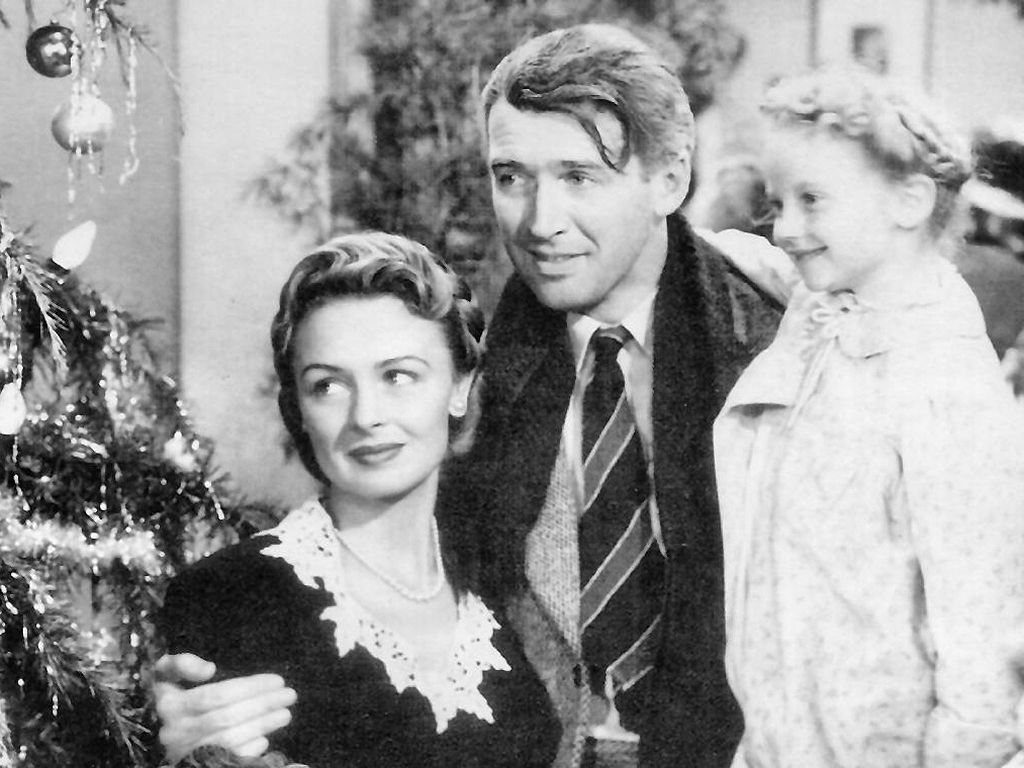
Photo: National Telefilm Associates. But you knew this was Jimmy Stewart, Donna Reed and "Zuzu" from It's A Wonderful Life, right?
This is kind of a review of a book of eleven short stories in the alternative history genre, but it's also kinda not...
I started reading this book because I needed to learn the genre, in case I should need a touch of it for my current novel. I may, but if I do, I'll look to the likes of "A Christmas Carol," or It's A Wonderful Life, which are essentially of the same genre. The first is a story of what Scrooge's life would be like if he doesn't change. In essence, he creates an alternate history by changing, as his dream advises. In the latter, George Bailey witnesses an alternate history of his town if he hadn't been born. They're both inventive and useful (if not life-affirming) exercises, if nothing else. Maybe I'll write each of those some time, just as morning pages.
By the way, an excellent example of this is Ray Bradbury's "A Sound of Thunder," which is the genesis of the phrase "the butterfly effect." In this one, a hunter goes back to the Jurassic--via a time machine and a company that brings you back, tracks a dinosaur that's about to die soon anyway, and puts a red mark on it so you know what to shoot. The catch: Do not step off a hovering path they lay out. If you do, you may step on a plant that was supposed to feed the animals that were a descendant of present-day buffalo, which supplied everything for many Native Americans...you get the idea. (That was my example.) So of course the guy steps off the path and steps on a butterfly. They return to their present that is now very different...Very worth your time.
Anyway, the eleven stories here are largely unimpressive. Mostly they're not stories; they're an actual history--like from a dossier, or a history book--of what would've happened if Benjamin Franklin had created the steam engine (there'd be flying machines in the Civil War and Crazy Horse would've flown them for the different U.S.) or if the French Revolution had ended differently. You get the idea. The complaint here is that most of them weren't stories; they were inventive--and sometimes over-inflated--histories told too factually that seemed of interest to the writer, but weren't to me. There just wasn't story. Seven of them struck me this way--7 out of 11. That's too many. And they were so long that I just skimmed them.
The better ones had story. A plot. For example, Napoleon is your irritated, and irritating, next-door neighbor. You feel bad for him because he's dying, and because he's unhappy that he hadn't climbed to a higher position than lowly lieutenant in the French army: "The Curfew Tolls." Or, you're the bomber pilot who doesn't drop the bomb on Hiroshima. You get tried for treason. Can you convince them you did the right thing? That's the best one: "The Lucky Strike." Or, the South wins the Civil War. The North stays the same, but the south is taken over by the suddenly-free slaves. But they fight amongst themselves, can't agree on a universal language from Africa (because they came from so many different countries and tribes), and the south falls to shambles and is about to be attacked again by the north. And the story starts with a Silent so crazed with his life that he literally beats his head against the wall nine times before he dies. Now that's a story! The very good "Hush My Mouth." There are some good parts of one or two more, but...
So this one should mostly be a pass, though the ones I liked I liked so much that you may want to check this out of your library and peruse the ones I recommend. It's a different genre; but some of the stories in this book are better thought about than read. But the ones I liked were very good.
BTW, speaking of alternative histories, and this is truly a sign of the times: An anthology is in the works now of an alternative (and, by definition established by the genre, worse) America if Trump becomes President. The website says it's receiving a lot of good, horrifying stories. Think Back to the Future 2.
Subscribe to:
Posts (Atom)