Showing posts with label child. Show all posts

Friday, January 20, 2017

Harlon Coben's Home: How Far Would You Go to Defend Your Child? Is It Ever Too Far?


Photo: from kirkusreviews.com, here.

It's been awhile since I've read a Myron Bolitar novel. I don't remember why, exactly. It's just one of those things: I picked up Nesbo, stopped reading him for awhile...and I've been reading other things since. But when my neighbor, a huge Bolitar / Harlan Coben fan (I'm more a fan of the latter than the former, because Coben was nice enough to buy me lunch once, and talk to me about how he wrote--but that's another story) asked me if I wanted to borrow his latest--in return for my letting him borrow all my Bolitar books--I said sure. (Thanks, Jim Fitz!) As it's a three-day weekend, and my sinuses are again out of control and I feel like crap, I started reading it and didn't put it down except to sleep. I started it yesterday and finished it today. (I read 90% of it yesterday, so there wasn't much to finish.)

It was that good. The mystery is very mysterious, and the pace and tension are so good that you'll be flipping pages, fast, like I did. The gist of the book is the title, though more specifically, it's about who your home is, not as much about the structure. Home is where the heart is, right? So where's your heart? That last question means more to the book than you'd think, and more than I'm letting on. (I'm a little proud of myself for this.) The book is about how far we'd go for our loved ones--specifically, how far a mother will go to protect her child.

The short answer: Very far. I know this. At my job I often see this, parents going to ridiculous lengths to defend their kid, even when the kid doesn't need defending.

This is an important distinction. We all know bad parents, right? Someone who lets the kid get away with everything: talking back, and badly, to them; showing bad manners, like not thanking people for gifts; and, perhaps the worst, defending them about everything, to the extent that nothing's the fault of the kid, so the kid never learns to grow up, to be responsible, to be self-reliant. We all know parents like this. Right now I'm sitting here, counting the ones I know who fit this distinction to a T, and I'm thinking 4, maybe 5--wait, there was a 6th, from a few years ago. It's more often the mother than the father, from my experience, though that last one had both.

So this book is about that question: How far will you go to defend your child? But...does the child need defending? And are you really defending the child, or are you defending, and / or celebrating, yourself? You ever see a parent so out of control with this defending thing that you wonder who, exactly, they're defending? Is it the kid who can never be wrong, or the parent who can never be wrong--so the parent, of course, couldn't raise an imperfect kid. Good God, if that happens, then that means the parent is also imperfect, right? Well--No, but they don't know that. Narcissists are not known for their logic. Watch for that, next time: Is the kid perfect, or is the parent defending the kid perfect, which is why the kid is perfect? From my experience, it's the latter.

This book isn't just about that, of course. It's about Win. In fact, it starts off with him, which threw me for a minute before I figured it out: Win's chapters are 1st-person narration; Bolitar's are third person. Limited or omniscient, you ask? Ah, there's my own caveat. (You knew there'd be one, right?) The third person omniscient narrator is almost a character himself. He hides behind the curtain, but he's there. He breaks the fourth wall to remind you he's there. Sometimes he masquerades as Bolitar's thoughts and voice-overs--and, unfortunately, sometimes it's hard to tell the difference--but he's there, trying very, very hard to be hip and snazzy. This third-person narrator (who reminds me a little uncomfortably of the narrator Snowman in those Christmas cartoons of the 60s) interrupts his own narration to often point out the obvious, or to point out the cliche, or to introduce the cliche, or to...You can either take it or you can't. Most of the time, I could.

I wish overall that Harlan Coben wouldn't do this, but I understand why he does: Something has to set the writing apart, right? Lee Child, Dennis Lehane, Harlan Coben and a couple of others--Frankly, they write about the same genre, and the almost-same plots, and something has got to be different, right? I'm thinking now of Robert Parker's last 10 books or so. If you threw a title at me, and asked me to summarize the plot, I wouldn't be able to do it. I suspect that if I'd read all of Lee Childs's, or all of Coben's, I'd say the same about theirs. That's not exactly a drawback, either: One of the odd things about the genre is that a series character is like a pair of comfortable slippers. You slip them on, and you forgive their age, or their holes, or whatever, because they're comfortable. That the genre's books all blend together is actually part of the charm, not a detraction. The way to tell Coben's Bolitar apart from Parker's Spenser (as an example)? Why, Bolitar books have the narrator who frequently breaks the wall and speaks directly to the reader, even going so far as to use the second-person "you." That's no small thing, by the way, and it's a way to ease your feet back into those comfortable slippers. Every mystery writer wants a series cash cow with a main protagonist and his questionable sidekick / partner. Coben has Bolitar and Win as Parker had Spenser and Hawk. And, of course, if it works--which Coben's series obviously has--then you keep going, right? And you don't fix what's not broken.

So read this one, because the tension and plot and mystery are so good that you'll forgive the third-person narrator's trespasses, if that's even necessary for you to begin with. And at the end, you'll have a moral question to answer: Did the character go too far defending the child? (I'm having an image now of the adults who beat the piss out of each other to get the latest Christmas must-have. Remember those videos of grown people beating the snot out of others so their kid could get the store's last Tickle Me Elmo?) I would say Yes, because of the people I explained above, but I'll bet quite a few people will also say No, that you protect your child at all costs.

Even if the child doesn't need defending.

Tuesday, September 27, 2016

Why You Shouldn't Vote for Trump 2

This is a continuation of a series of blogs that list reasons you shouldn't vote for Trump. The first of the series is here--just click on these words.

Now, following by far the worst performance I've ever seen in a debate, are a few more:


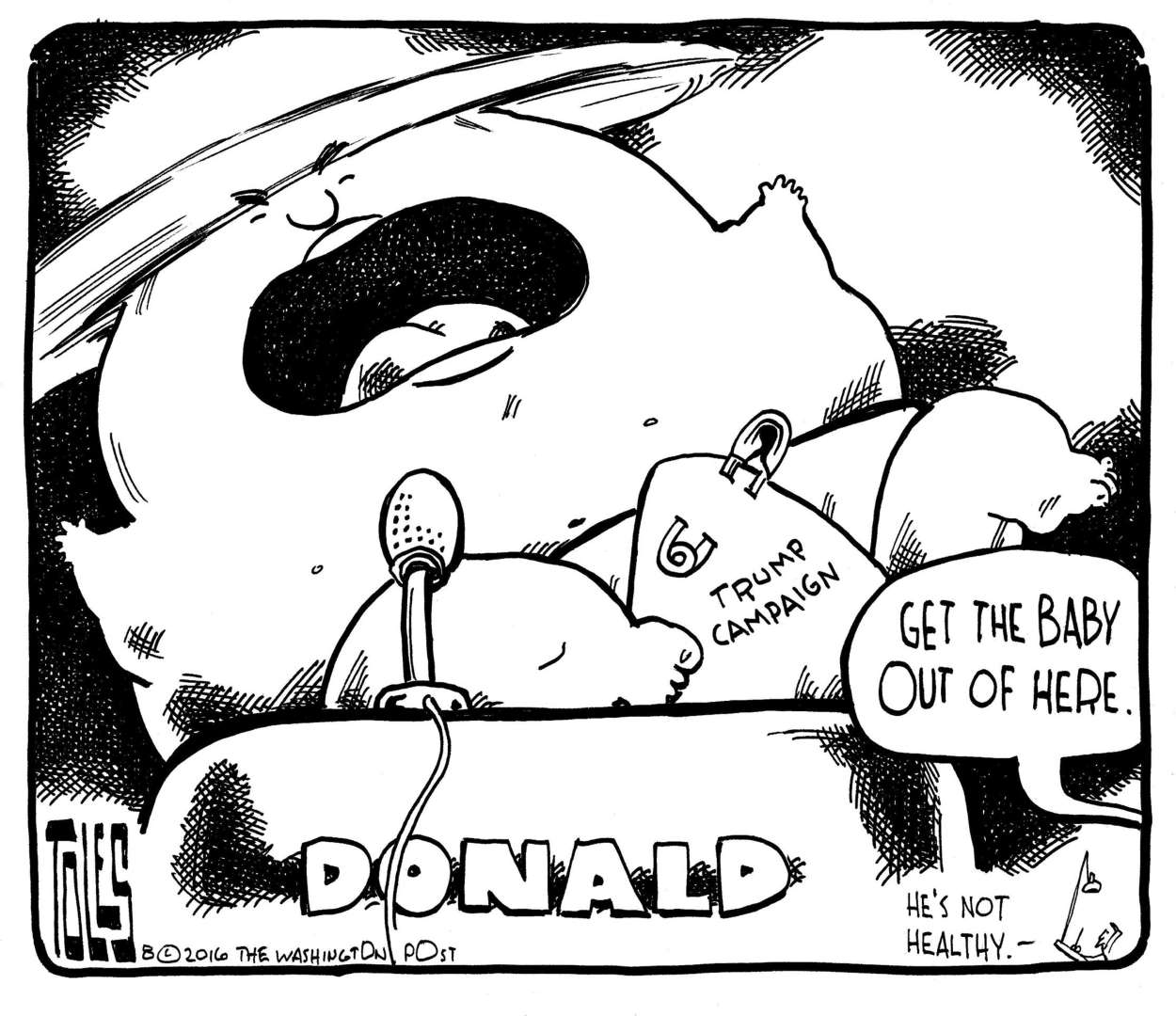
Photo: You don't have to have seen the movie Airplane to appreciate this, but it's a good point.

--He hasn't released his tax returns, the first political hopeful in over four decades to not do so. He said in the debate that the IRS suggests he not release them until their audit of him is done--long after the IRS had made it very clear that he can release his tax returns before they finish. During the debate, he said they've audited him for the past fifteen years--so it's clear that he thinks they'll be auditing him for eternity, and therefore he never has to release them. Why isn't he releasing them? He also said that his lawyers have told him not to release them--without ever saying why this is. If that's true--which I doubt--then why are they telling him not to release his tax returns? Why is his campaign manager telling him not to release his tax returns when she knows it's a major critical point, and that everyone else in recent memory has done so? Why does everyone who knows about his tax returns tell him not to release them? Why? Why? Why? Are there illegal things in there, such as how he's handled his 6 bankruptcies? How he's shipped many jobs overseas? How Trump University is a Ponzi scheme? Or has he not paid any taxes in recent years? (My guess: many, if not all, of these.)

Why hasn't he released his tax returns?!?


Photo: from the New York Times article, linked below.

--He doesn't know what he's talking about. This is true with every non-offensive word that comes out of his mouth, but is especially true when you look at his first 30 minutes or so of the debate. In what was considered the better part of a pathetic performance, he said absolutely nothing accurate at all--a big problem for him, since his core message is that he's a businessman who can fix the country's bad business. But don't take my word for it. Look at this piece at Vox.com.

I've said recently that the country's job market wasn't that bad. Someone screaming something at you relentlessly doesn't make that thing correct, just loud. (And never let someone control you with fear. Beware of those who try to win you over with your own worst fears.) The bottom line is: jobs have grown for 78 straight months, the longest streak in history. The job market is growing here--for now.


--He acts like a child. There are so many examples of this, I won't insult your intelligence by belaboring it. Do you want this guy representing you to the rest of the world? Don't you cringe every time he opens his mouth? Look at the cartoon above. This is but one of hundreds of examples.

--He has absolutely no political experience whatsoever, in any way. Not even in a city council, or a school committee, or anything. Nothing. Nada. Zilch. Zero.

--Whenever he hints at Bill Clinton's infidelity, he seems to be forgetting his own. Or don't you remember the divorce from Ivana, when he fooled around with Marla Maples? How can you forget a name like Marla Maples?!?

--He's a liar. About a great many things, but to such an extent that even The New York Times, which goes out of its way to be fair, had this to say about why it officially calls him a liar.

--He mentions such irrelevant people as Rosie O'Donnell in a debate that the entire world is watching. Again, that's a bit immature, isn't it? Rosie O'Donnell has as much to do with the Presidency as Bill Maher did when Christine O'Donnell defended herself against his accusation that she was a witch. Just not somebody who should be holding an important political office.

--He's orange, and he acts like a buffoon. And he didn't answer a single question Lester Holt asked.

Saturday, May 28, 2016

Now This Is Messed Up

This, from the San Francisco Chronicle:

A coffin over 130 years old was found beneath the front porch (of a Ms. Karner) in San Fran recently. It contained the body of a little girl. Authorities figure it's the body of a girl who had been buried with many other people in cemeteries all over the city, but who had been moved in the 1930s to create room for city expansion, or urban sprawl, or overpopulation. Whatever. The point is: this little girl's coffin was left behind and not moved with everyone else in the 1930s. So just put it where all the other bodies had been moved in the 30s, right?

Not so fast:

That nearly century-old mistake presented a big problem in the present for Karner, who told KPIX that she was left without an option by the city for what she could do provide Miranda a final resting place. The city wouldn't claim the remains, because Miranda was properly buried, but it also wouldn't let her rebury the casket, because Karner could not present a death certificate. The result was that Miranda just remained in limbo in the backyard.
"It put us in this position of having this individual in our backyard and feeling awful as a mom knowing this is a small child," she said.
Lucky, Miranda's story is finding its resolution. Garden of Innocence, an organization that facilitates "dignified burials for abandoned and unidentified children," has offered to rebury her casket this summer.
Me, again. (Sorry for the type change, but I can't seem to fix it.) So, two things:
1. The city won't claim the remains because she'd been properly buried? Didn't it claim the remains of the hundreds of bodies moved in the 1930s? Or, why doesn't an enlightened city administrator (If there is one; we lack one here in my neck of the woods.) just use a little common sense, cut through the red tape, and bury the poor girl with her ancestors? Is that too much to ask?!?
2. So we live in a world where we need a charitable organization that pays for "dignified burials for abandoned and unidentified children"?!? Why are these children abandoned and unidentified? People just drop off or leave behind bodies of dead children? Are you @#$% me? And why isn't the city paying for such a thing as well?
Now that's messed up.

Wednesday, August 19, 2015

Comfort by Ann Hood

Photo: from Ann Hood's webpage, here.

When a 5-year old child dies...Well, I can't really even finish the sentence, much less write a book about it.  Such loss is inexplicable.  It is impossible to imagine, even by a person like Hood who makes her living from her literary imagination.  The talent to do so must be immense.

You have to do honor to yourself, your own emotions, the child, to the death, to the reality of how it happened.  The details.  The exact details.  Details so exact you have to live your own worst nightmare over and over and over and over just to get the details right.  Because to get them wrong--purposely wrong--is a sort of blasphemy.  Yet you also don't want to sound whiny, or maudlin, like you don't realize other people have lost their kids, too.  You have to write about the cold hard facts, and how do you describe emotions at all, especially as cold hard facts?

And you have to write it well, not like a diary or a journal.  You have to write it over and over, drafts innumerable, to get the tone of everything above, and everything I can't even think of, just right.  It is a high-wire act, a balancing act of art, and therapy, and confessional, and literature, and a sort of diary-journal in memoir form.

I'm a writer--hopefully a pretty good one--and I can't imagine ever being able to do this.  Ann Hood, a former (or current?) Rhode Island College professor [full disclosure: I attended RIC but did not have the good fortune to get Ms. Hood as a professor, though of course I did have some good ones] does the high-wire act and succeeds because her writing is that direct, that honest, that good.  This book will jab you with its simplicity and it's reality.  Not realism, which is a fakeness of literature that makes the unreal real.  This book is all real, all the time.  It is one of the heavier 186-page book you'll ever read, and read it you should.

It doesn't matter if you've never lost a child.  When you reach a certain age, as I guess I have, you've probably lost somebody, and no matter how old they were, I'll bet you thought they weren't old enough.  And you're right.  At least, I think you are, because that's how I've felt about my loved ones who've died.  In fact, I feel that way about everyone I know who've died, even those who were quite old.

More than the death of her child, that's really what Comfort is about: Death.  The death of anyone.  Anyone you've loved.  Anyone you thought died too young.  Weren't they all too young?

Of course, it's harder to explain when they are really that young.  How do you explain the death of a 5-year old girl?  Especially when it's your own daughter, how do you explain that?  Another thing this book tells you is that there is no explanation.  There's no Why.  How can there be?  How can we possibly understand why such a thing happens?  Hood makes it very clear right away, and reminds us throughout, that she doesn't know why it happened.  She doesn't have a belief about it, either.

It happened.  That's the source of the grief, and maybe of the comfort.

It happened.  And there is no why.

A remarkable work that deserves to be read.  When you're done you'll feel something, which is what good books are supposed to make you do.

Wednesday, October 29, 2014

Last Night in Montreal by Emily St. John Mandel


Photo: from the author's webpage and bio section.  It's on her latest books, too.  And in Entertainment Weekly, which says that her newest, Station Eleven, is "the must-read of the fall."  I don't doubt that it is.  I love her writing, from her first book, reviewed here, to her online essays.  Good writing is good writing, no matter the form or the genre.

An exquisitely-written, stays-with-you little gem of a book, more about the people who are left behind than about the people who leave.

Very short, at 220 pages, but very deep about obsession, depression, leaving and staying behind.  The characters are all representatives, of course, more than they are flesh-and-blood, exactly, which made me hate Lilia a little less at the end, when we learn in the last few sentences of the book that she lived happily-ever-after (mostly) after all, despite all the (mostly unintentional, but c'mon) heartbreak she left in her wake.

But she has been thrown through a window, seen a man driven off the road, seen a woman pulverized by a subway train, and she never had a lasting friendship or relationship until she married in her late-20s after finally staying somewhere--in this case, Italy.  Some reviews hated on her character, and I could see their point, especially how this waif with tight dark hair just so easily grabbed relationships with men and women (bisexuality is hinted at in the book)--and all she has to do to get them is to read in cultured little coffeeshops...  Yet, I don't doubt that there are a lot of Lilias out there, and that there are indeed affected women who sit in coffeeshops all the time, and bookish male intellectuals trip over themselves to be with them.  Plus, looking at the author's picture, I think it might be a bit of a self-description.  Maybe a little Freudian analysis is necessary here.  But I digress...

Lilia is representative of a type, and not full-blooded, so I ultimately gave her a pass.  After awhile of thinking about it.  Plus, I'd sit down next to her in a coffeeshop...

But all the characters are this way.  They're representative, and many of them come off far worse than she.  There's the aforementioned mother who threw her young child out the window...which was closed, by the way.  And she left the child in the winter snow to freeze, too.  Luckily that didn't happen--the freezing, I mean. 

Then there's the detective father who is the real obsessive of the book.  He leaves his wife and daughter for weeks, months and, yes, years at a time, to track down Lilia and her father, long after her abduction ceased to be worth tracking down.  (She's in her 20s, and plus she was better off away from the free-throwing mother.)  This guy's wife leaves him, then he leaves his 15-year old daughter alone as he again obsessively tracks Lilia down.  Ultimately he ends up returning to his young daughter for a short time, but then he leaves again and disappears forever from her life.  It's possible he commits suicide somewhere. 

This girl, his daughter, quits school, which he doesn't notice, and eventually befriends Lilia, and then her ex- (who Lilia leaves at the beginning and who tracks her down in Montreal, in a fashion, but he actually latches on to this guy's grown-up daughter, kinda gets obsessed with her for two weeks and never really seems that intent to find Lilia...) and then she becomes a stripper, learns something even more unsettling about her father, and then kills herself.

She's the real victim here.

The above paragraph may make the book sound like a soap opera, but it's really not.  In lesser, untalented hands, this would have been a real mess, and worthy of mockery and lampooning--but it's in great hands, and really stylishly and compactly written.  It's not my kind of book, normally, but there's huge buzz right now about Emily St. John Mandel's Station Eleven, so I wanted to read her early stuff first.  I also read a couple of her online articles--one about NYC's reaction to Ebola before the doctor got sick there--and those were very well-written as well.

You've got to read this one.  For the writing.  For the interweaving structure.  For what it says about those who leave.  And for what it shows about those who are left.

It's well-constructed, a bit haunting and lyrical, and it'll stay with you.  It'll resonate.

And, oh yeah--Don't go to Montreal in the winter.

Wednesday, August 7, 2013

American Horror Story: Murder House


Photo: 1120 Winchester Place, Los Angeles, CA.  This is the real house used in the series.  From the show's Wikipedia page

I decided to view Season One of American Horror Story after viewing Season Two and liking it so much.  Season One was also good, though not as much as Season Two.  The writers seemed to have written themselves out of the main characters, as the secondary ones take over here, and where they go is interesting, but since they're already dead, you care less about them as characters.

At first the very dysfunctional family of husband, wife and (suicidal) high school daughter move into this (very) haunted house.  Turns out, the house has many ghosts in it: a gay couple, murdered fewer than three years before the current occupants; a surgeon who can't pay his bills, and the wife who shot him, and then herself; one of his freelance abortion patients; and, most dangerously, a teenage psychopath who had killed many students in his school before he was shot in his bedroom by the police.  He's a very angry, or still-psychotic, ghost who later kills the gay couple (and does something really nasty to one of them with a fireplace poker), and later rapes the mother, a current occupant, who later dies giving birth to what the show insinuates is Satan's spawn.  Was the killer used by Satan, or was he evil to begin with?  Or both?  The viewer can decide, but the characters themselves conclude that he is just pure evil, and the Devil's spawn angle is downplayed, though never really done away with.  And there are many, many other ghosts I haven't written about here, some of whom have little, if anything, to do.

Therein lies the problem of the first season: the writing in the last six episodes or so meanders, and seems very unsure of itself as it does so.  The Black Dahlia is introduced without reason, more as an homage to the L.A. noir style itself, and maybe James Ellroy, who famously wrote about her, and who infamously said she may his mother, or that her killer may have been his father, or both, I forget.  Other homages include Francis Ford Coppola's Dracula, in the sense that the movie's music is played in almost every episode.  Other movies in the Dracula, Frankenstein, and Southern Gothic modes, as well as lots of Rosemary's Baby, The Omen, and the like are paid homage as well.  Part of the joy of the series is catching and appreciating all of them.  You don't have to know them, though, to appreciate the series.

But back to the uneven writing.  What to do with the family?  Well, the writers didn't seem to know, either.  What to do with the many very unhappy ghosts?  In a nice twist, the family of ghosts ends up a much happier trio together than they ever did while they were alive.  Is the American family unit the "horror story" of the title?  It certainly seems that way, except the adults are so caught up in their own garbage that they don't even realize their daughter is dead.  (Though, to be fair, she doesn't know this, either, until she's told.)  The most wacky thing to me was that none of the ghosts seems to care too much that they're dead.  This is especially true of the father at the end, who is the only one left alive, and who seems to have the most to live for--his new child.  When he's killed by the ghost of his very young mistress (Kate Mara, older sister of Rooney Mara, from The Girl with the Dragon Tatoo), he seems mildly chagrined, at most.  The mother also doesn't seem to mind, though she knows she's without at least one of her newborns (she's told the first one died, but it didn't, and that's the one she ultimately ends up caring for); she also doesn't know her daughter's dead until her daughter visits her and says to let go of the pain, which the mother does.  (This seemed like too much of a condoning of suicide for me, which is how the daughter died, as well.)  Anyway, if the characters don't seem to take their lives very seriously, how can the viewer?

And that's the whole point at the end: the series creator's don't want you to feel sad for the family, and you don't, as they're clearly happier and better off than they had been.

How does it want you to feel about the Jessica Lange character, the devious and unsaintly and witchy neighbor who had lived in the house with her psychotic son, her wayward husband, her loose maid and her other two children, all of whom die before the very end?  Well, good and bad, in turns, though at the end she's gotten what she's asked for--a grandchild--but does she really want to take care of Satan's spawn?  I don't know, though I doubt it.  Jessica Lange does great work with a meandering role that makes her a victim and a killer.  You feel badly for her, because most of her siblings are dead and/or psychotic (and, in one case, both), but you also see her kill her husband, their maid, and almost the daughter next door.  In that last case, the daughter and her mother are victims of three psychotic people who want to kill them as others had been killed in the house.  Luckily, one of them eats the poisoned cupcake meant for the daughter, and...here's an example of the meandering.  Turns out, this entire series of events was unnecessary to the outcome of the whole thing.

So, at the end, this was like a good horror movie.  Riveting and sometimes creepy while watching it, but the second you think about the whole thing afterwards, it is very easy to see its many flaws.  But, if you haven't seen any of it yet, I do recommend it, especially if you're knowledgeable about the genres it pays homage to.

Tuesday, July 30, 2013

Shea Allen, Fired Reporter--Personal Blog vs. Public Job


Image: Shea Allen, former reporter for an Alabama news station, on a happier day.  From an article on dailymail.co.uk, here.

Shea Allen, former on-air reporter for an Alabama news station, was recently fired for re-posting a list of ten confessions, each of which had to do with her job.  She has stated that she was fired for the post, and that she (and maybe half of the commenters) are aghast about this.

Before reading the rest of this, take a quick look at her blog entry.

If you'd read the comments, you might've noticed that I'd deleted a comment that I had, for about three seconds, originally published--and I did so before I copied it, which shows you how dumb I am.  Now I have to try and remember what I'd written, and put it here as honestly as I can.

The reason I responded at all is because I also have (and still have) a very public job. My response went something like this:

Wait!  Genius that I am, I figured that if I just pressed the BACK button enough, I'd get my list back, and I did.  I wrote it as if I were writing to her, since I'd been responding to the entry on her blog.  So, here it is, and afterwards I'll explain why I deleted it there and posted it here (besides the obvious copyright infringement, if her site is copyrighted, which it should be):

--You have a child to provide for.

--You had a public job. You were a public figure.

--You showed up a public employer, in the public realm.

--You needed to show that you took your job seriously, as well as the responsibility of reporting the news and of putting it before yourself.

--You risked lowering your news ratings by alienating your largest demographic. If the ratings plummeted, you, and others, may have lost your jobs.

--You posted all of this in a public forum. On the internet, there is no such thing as a private anything.

--You showed incredibly poor judgment and really bad decision-making skills.

--You were unprofessional, and in a very public way.

(Me again.)  I would argue that these are all valid points (you can comment so if you disagree), but I think the one that would surprise her, twenty-six year old, pretty woman who has grown up in the technology age that she is, is the one in which I said that, on the internet, there is no private anything.

The argument she poses is that her blog is her "personal" and "private" blog, and the (public) station had no right firing her over it.  This is, of course, nonsense.  There is no personal or private anything on the internet.  Period.  Her ignorance of this, considering her job, is astoundingly immature.  Another facet of this point, that I didn't at first mention, is that she even makes her station look bad by not moderating the comments on her blog.  Have you read some of that stuff?  She let complete idiots use any language they wanted to comment about her blog, about what she does, and about what she thinks re: working for her public news station.  She didn't even moderate the comments!  She didn't even try to moderate the attention she received--she took it all!

What public figure does that?  Even I moderate the comments on my blog--which drives away those who want to leave a stupid or juvenile comment.  Her failure to do so is a clear example of poor judgment and bad decision-making.  Just that alone--never mind her comment about her fear of the elderly (I'm going to guess that at least 75% of this nation's elderly watch some sort of news program) or about stealing people's mail.  I can't imagine Murrow or Brokaw posting a blog like this, had they been able to.

It just wasn't professional.  And letting the riff-raff post juvenile comments is another example of that lack of professionalism.

I have a public job.  The reader will rarely, if ever, read about it here.  Instead you'll find probably more than you want about my thoughts of the movies I watch, the books I read, and the non-job-related thoughts (none of them controversial) I have about things (I feel one brewing about people who never take down their yard sale signs).  My job?  I simply don't mention it.  Why?  Because it's not professional.  Do I have things I'd love to vent?  Sure--Who doesn't?  But I don't.  Because I'm an adult.  Because there's no such thing as a private, or just personal, anything on the internet.  Because, fair or not, that's just the way it is.  And at my age, I'm way over "That's not fair!" being a winning reason about why I do anything at all.

And it's more than that.

Bottom line: I like my job.  A lot.  And I have a mortgage to pay, and things I want to do in which I need money.  I like my (very minor) social status.  For example, I get many hellos when I go to Dunkin' Donuts drive thrus.  It ain't much, but it's all I've got, and I like it.  This former reporter showed she didn't like her job and she didn't take it seriously.  How do I know this?  Simple.  She re-published the blog after she was told to take it down.  She did take it down, at first.  But like some petulant child, she re-posted it, thereby giving the finger to her bosses, and showing her ignorance for the very good reasons about why they told her to take it down to begin with.  I guarantee that their #1 reason was her quip about fearing the elderly, and about how she will not do any story about an elderly person, ever.  That's the demographic, man.  The elderly watch the station, which shows ads, which makes it money, which the station uses to pay its reporters, of which she had been one.  It's that simple.  She very publicly cost her employer money, and she very publicly made it look bad.

And she let any idiot comment on it.  Do you think Brian Williams would post an incendiary blog in which any moron could respond by using whatever word at all he wanted to?  That alone would make NBC look bad.  And so I deleted mine, because I didn't want to be one of those, although many commenters were fine, and adult.  But when I realized that there wasn't any moderating going on (and, yes, I should have realized that sooner, before I was just asked to re-type two words, and then saw my response published), I decided that I didn't want to be a part of that--and that my response would make a better blog entry, since I also have a public job, with very public responsibilities.

It's just part of being an adult.

And, as a last caveat, her blog page says that she is still a reporter at that station.  She isn't, and wasn't even professional enough to edit that on her blog.

What do you think?  Should she have been fired?