Showing posts with label Pedro Martinez. Show all posts

Saturday, November 11, 2017

Pedro by Pedro Martinez and Michael Silverman


Photo: the hardcover, from its Goodreads page

Better-written than usual for this type of book, Pedro nonetheless continues a string of multi-millionaires complaining of lack of respect and then throwing their teammates and colleagues under the bus. Mike Napoli, for example, may wake up one morning, read a page of this, and wonder WTF?

It is well-written and it has a better narrative flow than is usual for the genre. Michael Silverman has created a structure of Pedro's voice, narrative voice (certainly not Pedro's), author voice (same) and then enmeshes direct quotes from others, like you're reading a screenplay of a documentary. It doesn't sound like it works (and, sporadically, it doesn't), but overall it does work and you read on.

You get the childhood background, but without the grittiness that you think the self-proclaimed poverty would demand. It's smoothed over when maybe it shouldn't have been, but then this isn't really a documentary, it just sounds like one. You get the beginning, with the Dodgers, then the other teams: the Expos, the Red Sox, the Mets and the Phillies. (Did you remember that Pedro's last start was in the 2009 World Series against the Yanks? I did, but it seemed surreal, then and now.) You get the typical beef about the management: the Dodgers and Sox especially.

And this is the first of two things that made me rate this a three rather than a four: it's hypocritical about two things, so glaring you wonder they weren't amended. The first: Every Sox fan knows Pedro's last game was Game 4 of the 2004 World Series. Immediately he let it be known that he wanted a 3-4 year contract, and the Sox wanted to give him the shortest one possible, a year, or two, at most. That was known before the season ended and for as long as it took for him to get a guaranteed 3-4 year deal with the Mets. And it was also known that his shoulder and arm were frayed. More time on the DL; more injuries; more babying at the end...All of this was known. And it was just as well-known that the Sox were right: Pedro had one good year left for the Mets, and then the rest of that contract he mostly spent on the DL. If the Sox had given him a 3-4 year deal, they were going to eat 2-3 years of it. They said that out loud, and they were right. If you were Sox ownership, do you make that deal? The Mets did, as they candidly said, because they had a newer ballpark and the fan base was dwindling, and they had to bring in a name.

The hypocritical part is that this book whines about a lack of respect from the Sox about all this--and then shows in following chapters that they were right! He acknowledges he lasted just one more good season (a very good 2005) and then had one injury after another. The 2009 season with Philadelphia was a half-season for him--he was 5-1 and basically started in September. The rest of the year he was the same place as the previous three--on and off (mostly on) the DL. He narrates all this without saying the Sox were right, but clearly shows in his narration that the Sox were right. He calls it a lack of respect that the Sox weren't willing to give him a long guaranteed contract and then eat 75%-80% of it. But of course that's not what businesses do. And the casual fan could see his physical regression in 2003 and 2004. It was obvious. I wouldn't have given him that contract, either. (He's made hundreds of millions from baseball and endorsements, so don't feel bad for him.)

The other blatant example of hypocrisy is how he states all book long that he was misunderstood, that he was mislabeled, that he didn't throw at batters intentionally, that he wasn't a headhunter--and then, often in the same sentence or paragraph, admits that he hit someone on purpose, and that he often told the player he would do so, and then does it. He threatened players verbally with it all the time, then hit the player--and then says he's misunderstood, that he's not a headhunter. This is so obvious in the book that you shake your head.

But, again, that's what these books do, right? They complain about money, about disrespect, about how the media screws them, all that same stuff all the time. It makes you yearn for another Ball Four, and to truly appreciate how direct and honest it was. Say what you want about Bouton, but he was well aware of how not a God he was, about how lucky he was to do what he did and to make the money he did, and he had actual thoughts to say, and didn't complain too much about management or anything else. Yes, he was traded for Dooley Womack, but he never says he shouldn't have been.

Thursday, January 6, 2011

Bert Blyleven and Superficial Thinking

Photo: Ed Walsh's T206 Baseball Card


For this post, I'm going to beg for your indulgence, especially if you're not a baseball fan.  There's a big-picture here, which mostly speaks to the power of the intelligent swaying the masses with intelligent writing, and it's also a little about the unfortunate and maddening need to have to do so.  It would not be a sin to skip the numbers a little, if you have to.  This will be long, so if you absolutely cannot bear numbers, or stats, or baseball talk, I'll understand if you scroll down to the last 4 paragraphs.  You'll miss the build-up, but you'll still get the overall point, I think.  (If you don't, scroll up a little and skim if you have to.)

I'm glad Blyleven was elected to the HOF for many reasons, but mostly because he's the poster child for sabermetrics.  (The importance of sabermetrics will be the subject of another entry.)  His stats, superficially below the Hall's standards for so long, now show why those standards were superficial to begin with.


Were the writers put off by his 287 wins--13 wins shy of the magical 300?  Were the writers that stickly?  300 wins, or else?  Even without the knowledge of WAR and other newer sabermetric standards (some of which I am honestly ignorant of myself), these writers knew what ERA was, right?  And WHIPs?  (That's walks + hits divided by innings pitched.  Essentially this shows you the number of runners allowed on base by the pitcher per inning.  Statistically, this absolves good pitchers who work for bad defensive teams.  It also shows you the occasional pitcher who has high WHIPs but low ERAs.  How can that be?  Answer: He pitches well in the clutch, when he has to.  Think Dice-K from a few years ago.)  I don't doubt that this was actually an issue early on in the voting.  But how could it have been as the years went by?  287 wins means he probably should have had 300, so why didn't he?

Look at his stats from 1971 to 1974.  In order, his won/lost records were 16-15, 17-17, 20-17, 17-17.  His ERAs were 2.81, 2.73, 2.52 and 2.66.  Here you have the definitive "problem" of his career.  In those 4 years, he was among the league leaders in wins and ERA each year; yet, all told, he won only 4 more games than he lost, and was also amongst the league leaders in losses.  How can a pitcher win so many games while losing so many games, and have good ERAs?  Simple: He pitched for teams who did not score for him, or did not field well for him.  This is odd, because (I'll have to research this) but the Twins at the time had Killebrew, Oliva and Carew and Olivo, didn't they?  They should've scored well, and often.  Maybe they just didn't for him, or they dropped the ball.  (sorry.)  That's odd, too, because Blyleven was a strikeout/flyball pitcher.  Hmmm...I'll have to come back to this.  The point is, though, that with a swing of 3 games a year--easily possible with his ERAs--then he's got a 19-win season and three consecutive 20-win seasons.  And 299 wins.  Pick up one more in all the years he pitched, you got your 300 wins, and your established peak value.  With those, there would not be a HOF discussion about him.

This also points out that win totals are often a lousy indicator of a pitcher's value.  With King Felix's Cy Young last year, this will be forever cemented in the minds of the voters.  He pitched for a lousy team that was one of the worst all-time scoring runs, and so he won just one more game than he lost.  But the voters, more savvy than in the past, correctly looked past that and gave him the Cy.  Imagine pitching for that team for most of your career--though not that bad a team--and you'd have a career much like Blyleven's.  Had Blyleven pitched for the A's or Yanks from 1971-1974, he would have easily won at least 22 games each year.  A quick glance at a Bill James Abstract shows that his teams were well below .500 teams in those years.  In 1973, he went 20-17 for a winning % of .541.  Not great on the surface, but spectacular when you see that his team played .488 without him.  In 1984, while with Cleveland, he went 19-7, for a .731 winning %, and the team played .412 ball without him.  That's an extreme example, of course, but it shows you what we're dealing with.  By the end of the 1986 season, he had 21.4 more wins above the rest of his team, according to James's Abstract published in 1988.  In other words, as mediocre as his .534 winning percentage is, it is far better than the combined winning % of the teams he played for.  In short, he played really well for some really bad teams.  (A quick glance at Nolan Ryan's stats shows you that, had he pitched for the Yanks for most of his career, rather than some very bad California and Texas teams, he would have won close to 400 games.)


To further prove this point, a few quick things I learned while gleaning other people's articles and blogs:

Joe Posnanski, a sportswriter for SI, points out that Blyleven won more 1-0 games than anyone else in the last 90 years.  Why?  Because he had to.  Blyleven, I mean.  At a guess, you'd have to imagine that he also lost more close games--or gotten a no-decision--than any pitcher in the last 90 years.


He's 13th all-time amongst pitchers in WAR.  This means that if you removed him from the roster, and replaced him with an average pitcher, that pitcher wouldn't be able to win as many games for that particular team than Blyleven did.  It takes a special pitcher to win for bad teams, and essentially Blyleven was the 13th best pitcher at doing that, all-time.  As a point of reference, Steve Carlton won 27 games and a Cy Young for a last-place team one year.  Blyleven (without pitching exactly as well as Carlton, in one year or for a career) did that almost every year of his career.


The obvious stats:


His 287 wins are 27th best, all-time.

His 3,701 Ks are 5th, all-time.

His 60 shutouts are 9th, all-time.  Since 1966, only Ryan and Seaver had more.  These last two things highlight another essential aspect of a HOF career: dominance.  If you strike 'em out, and you shut 'em out, you're dominating them.  If they can't hit you at all, and they can't score off you at all, you're dominating.  He was the 5th best and the 9th best at doing that.  Ever.


His 241 complete games is 91st all-time.  Not so hot on the surface, but from 1970 to the present, that'll be in the top ten.

He's a ROY winner, a two-time World Series winner, and he threw a no-hitter.


In 1985, he went 17-16 but led the league in games started, complete games, innings pitched, shutouts and strikeouts.  Again, if you finish what you start, and pitch more than anyone else, and they can't hit you or score off you, that's dominance.  He completed 24 games that year.  No one since 2000 has finished more than 10.  In 1985, when no one but Bill James was aware of these other benchmarks we've discussed, the Cy Young voters still looked past his won/lost record and he finished 3rd in the voting.

I could go on, but we've both probably had enough.  Why am I taking this so seriously?  First, it's very clear to me, and has been for a long time, before I ever knew anything about these other sabermetric benchmarks, that if you've pitched more innings than most, and you've struck out more than most, and you've shut down opposing teams more than most, then you're better than most.  And, if you're better than most, you should be in the HOF.  I knew this 14 years ago.  This is simple logic, and you don't have to be a sabermetrician to very clearly see this.

It is frustrating when people, in baseball and in real life, have a certain bias towards what they're looking for to the exclusion of everything else.  It is true that he doesn't have 300 wins.  It is true that he won 20 games just once.  It is true that he doesn't have a very obvious showing of peak value.  It is true that his peak years, statistically, may have come early, and since they came for a bad team, the stats they created don't look great on the surface.

But I hate on-the-surface thinking.  It annoys me--and often angers me--that sometimes that's the best that most people can do.  There's a lack of long-term, big-picture thinking here, of seeing the forest through the trees.  Blyleven wasn't the beautiful woman you can easily pick out of a crowd.  He's the beautiful woman who wears baggy sweatshirts who slips through the cracks of the minds of superficial thinkers.  He's the actually-attractive woman at the end of an 80s or 90s movie who the lunkheaded guy finally sees for who she is.  He's the guy who pitched for mediocre teams in the 70s and 80s that were not in NY or CA and therefore not on television most of the time for everyone to see.

He's the person you actually have to think about to appreciate.  And it took baseball's best 14 years to be able to do it.  And without a rabid fan base of sabermetricians and internet supporters, they wouldn't have.  He's not Pedro; he might not transcend eras like Pedro did.  But I tire of the articles and blogs today that make it seem like you have to be an expert in theoretical quantum physics to understand the numbers well enough to appreciate him.  It isn't so.  You just have to think.  A little.  Why is that so hard?

Wednesday, December 8, 2010

Boston Red Sox 2011

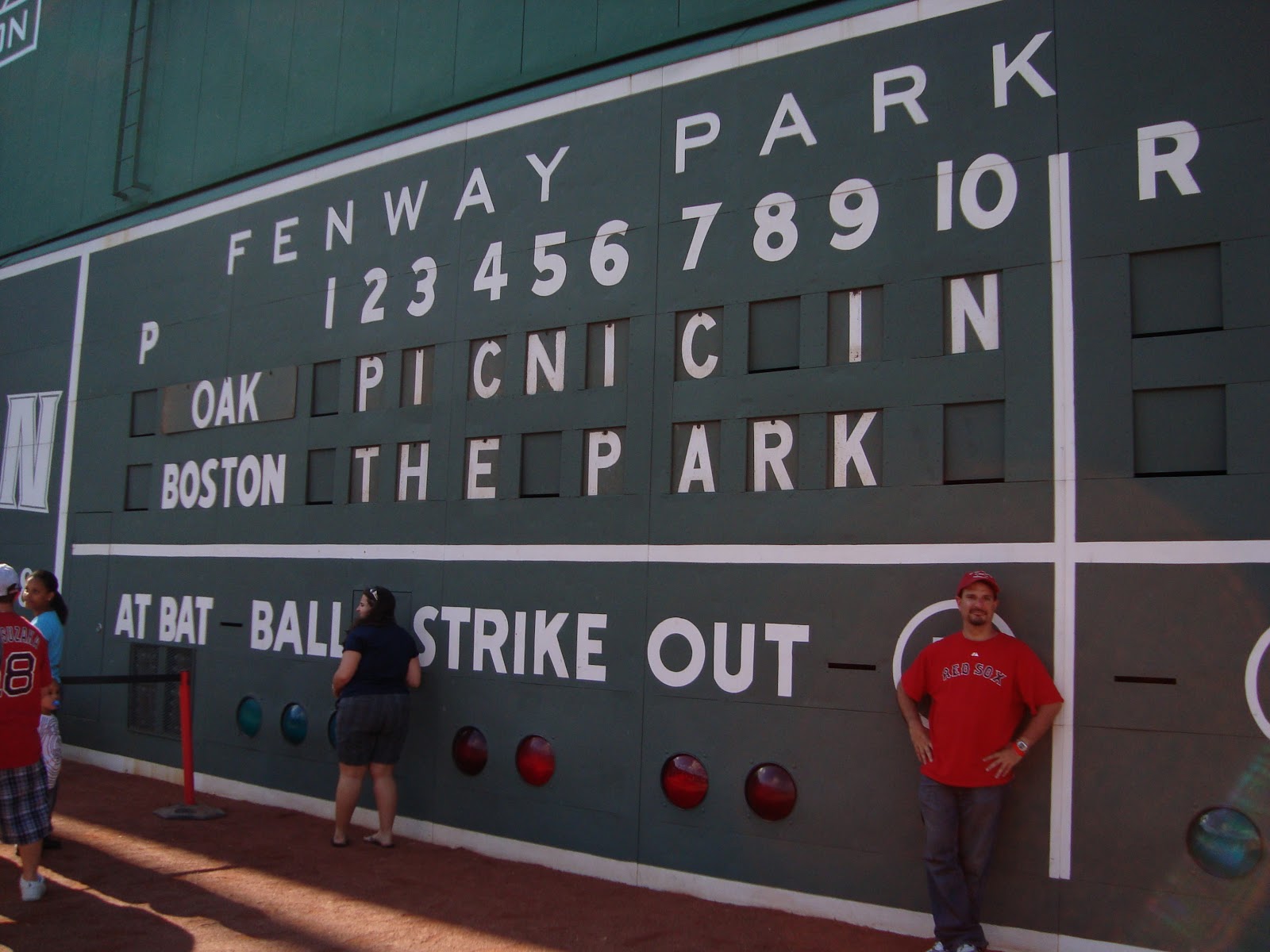
Photo: Me, in front of the Green Monster, during (see photo) a couple of years ago.

Okay, so this post is for my friends who've been talking non-stop about the trade.  I apologize to my readers who are not into baseball.  You can skip this one.

Well, so here it is.  Gonzalez is a Gold Glove at first, who transplants Youkilis, who was Gold Glove at first, and moves him to third, where he may actually be a little better.  So both corner positions are Gold Glovers, which you had last year before the injuries.  Under the plan beforehand, Martinez would've been your catcher/1B, and, though a good hitter, he is defensively challenged at both positions.  Youk and Gonzalez are clearly better at 1B defensively, and are both clearly better at the plate.  So Martinez is out of the picture at first.  Now, do you pay him 4 years for $50 million to be your full-time catcher and occasional DH?  In other words, do you pay him $12.5 million for the next four years to just catch for you, knowing that you'll have to give him about 30-35 games off, minimum, per year to save the wear and tear so he can be an effective hitter?  With his questionable defense and play calling, knowing he won't be at first or DH?  No way!  If you could put him at first on his days off from catching, maybe, but even that's a stretch.  I'd want to keep him, but not for that money.  And you clearly have to get Gonzalez if he's available, because he's a better hitter and defender than Martinez.  So, once you have all this figured out, Martinez is gone.  Fine.  A shame, and you get nothing now for Justin Masterson--who I was never a fan of anyway--but that's okay with me, too.

The biggest shame out of all this is that you lose Adrian Beltre and Casey Kelly, the latter of which I think can be a future ace of a staff.  But as Brian Rose and Carl Pavano (remember those guys?  the twin sure-things who both fizzled?  Pavano's still pitching, but he clearly stuck it to the Yanks) taught you, one definite is better than one maybe, so getting Gonzalez again is a no-brainer.  The other two prospects in the deal are also potential very good players, but that's why you draft such guys--to help your team on the field (Youk; Pedroia; Papelbon) or to help you in trades (Kelly and the other two).  Remember that Pavano and Rose got you Pedro Martinez.  That worked out pretty well, right?  And if Gonzalez can be 30/100 in San Diego, in a terrible hitters park, he can be 35/120, minimum, in Fenway, and the American League in general.

So then there's Adrian Beltre, who clearly has a perfect swing--down to one knee--at Fenway, and is a Gold Glove at 3rd base, too.  And a 35/120 guy himself.  (Youk is another 120 RBI guy, with fewer home runs.)  But where do you put him?  You have to keep Youk, who's a Fenway Favorite ("YOOOOOOOKKKK") like Ortiz, Pedroia and Papelbon are.  But he had nowhere to play now in the infield, and I'm a little worried at how he only has had monster years during contract years, and his 49 homeruns one year was due to a word that we will not mention here.  That's worrisome, though in his defense I think he enjoyed Fenway and would've put up great numbers and played great defense there every year.  I will miss him, and I think Kelly (whose autograph I have somewhere) and the other two prospects will turn out to be great players, but that's the business side of the game, which is just as important as the balls and strikes.

In short, you now have great hitters and Gold Gloves at every position in the infield (except at short, but Scutaro is unspectacularly solid), and you have Gold Gloves in the outfield with Cameron (when healthy) and Gold Glove caliber with Ellsbury (when healthy) and Drew makes it all look so easy when he glides after a ball, when he feels like it, and when he graces us with his outfield presence.  I wouldn't mind seeing Ellsbury back in center, and then a platoon in right and left between Drew and Cameron, and take your pick between the guys who did a good job subbing last year.  None of those guys, including Drew and Cameron are full-time players anymore--and excluding Ellsbury--so I wouldn't mind seeing Carl Crawford out there (the Nationals overpaid sickeningly for Werth).  BUT, you have to replenish your relief corps first, and if you do that and then don't have enough money left to sign Crawford, I am totally okay with that.  They fielded practically a minor league team last year in the outfield for most of the year, and were still second in the majors in offense, so they don't need another outfielder.  Get Beckett and Lackey back on track, and get a solid middle reliever or two, and if that's all you do, you're still going deep in the playoffs next season.